Tag: film

A bald headed newsreader with microphone in the snow outside of a cinema with Berlinale Palast and a red bear behind him,

Stories of politics vs the politics of stories…

Instead, is the heart of the Wenders vs Roy row not an older debate about how an artist should display their politics: on the sleeve or under the vest?

Do we want the overtly political cinema of One Battle After Another, the implied, less obvious and more allegorical politics of Sinners, or the universal ‘politics’ of love and loss in Hamnet that helps us see what we all have in common?

I don’t think it’s ever been either/or. Cinema, like any artform is all of these things. We get lost in rules on how to ‘express’ politics when it comes to picking a side in a social media culture war. Any artform can boil down the biggest ideas to a still-true microcosmic-expression of it. But rather than a few seconds of passing viral attention demanding zero ambiguity as it fights to win at The Algorithm, cinema takes people on a phone-free journey in a dark room to a more complicated place, releasing them a few hours later –very occasionally– as changed people.

Steps of an old classic-architecutre building with large columns - with a picture of purple fields stretched across the front, with two people dressed in evening wear entering thru the middle of it…

When the medium is a billionaire’s algorithm…

The bigger question for me around politics in art, relates to the platforms we use. If the medium is the message, how do we discuss politics when the medium is now a billionaire’s algorithm?

Our boolean age forces us into a this/that binary – pick a side, and fight it. It’s the first power system I can think of that actually wants us politically expressive, and the more extreme the better. To the algorithm this is content where extremism is more likely to catch attention, encourage encouragement, more eyeball-coin. But to us it’s fundamentally important stuff, the basis of what we believe is right and wrong, the decisions we make, that shape us. The platforms almost force us to either become apolitical or caught up in unfollowing, cancelling, defriending – cutting the perceived tumours away. That’s not new – Lord of the Rings to the Potterverse tapped into simplistic Christian-type good/evil binaries, but now, without a common religion to tell us right from wrong, and a perception of hypocrisy across conventional liberal institutions, we’re left with the billionaire’s algorithms monetising multiple sets of competing ‘moralities’.

But these algorithms have no moral compass beyond increasing their owners’ power and wealth.They care just that we’re malleable and glued to their daily content hose. Multiple sides pointing at each other convinced the other is their enemy helps that. Outrage, horror, sadness – this is monetisable energy; increased attention = more money.

This confounds us when it comes to responding. We’re now on a second Trump administration, not the first. Rallying cries push one side of the pendulum a bit, but ‘the other side’ seem to then push back at some point with similar force. The algorithms thrive on it, and while the pendulum swings back and forth we never really look long at who’s holding it. To be clear: what I’m saying doesn’t mean don’t vote or stop rallying – but that it alone isn’t enough.

The oldest trick in the book…

Non-billionaire fighting non-billionaire is the same age-old tactic feudal barons, dictators and tyrants have always found to keep us distracted from looking at whatever it is they’re stealing.

It’s not new, and it’s happening again with AI; the anti-AI and pro-AI voices are focussed on arguing with each other, not the billionaires who just stole the sum total of digitised human output –from our private messages to every book, song and film ever recorded- to train planet-burning models we’re bizarrely told will replace us unless we start using them all the time.

Which leaves the question if there’s anything more urgent politically than the question of our platforms? It’s not that the billionaire’s own them – if they own your TV or video camera you can still use it to shoot any story you want. It’s that they control the timelines we scroll for hours a day that filter and nudge our experience and understanding of reality.

Are we in too deep?

I write this on my Apple laptop. It will be hosted on infrastructure maybe owned by Amazon and Google somewhere. As we show in this issue, WordPress, which publishes this, have treated its co-founder pretty coldly. Modern life makes daily hypocrites of us all. But just because we all have a million and one reasons (or even followers) why we can’t change platforms doesn’t mean we have to surrender to apathy or indifference.

Because digitally, we can also exist in multiple places at once. We can use what we have to use for practical reasons, “render unto Caesar the things that are Caesar’s” while also “working as if you live in the early days of a better” world (Gray). Compromises don’t prevent us from hope, on the basis that it will have to happen sooner or later – that view of Dr King that “The arc of the moral universe is long, but it bends toward justice.”

Digital dissonance as a strategy…

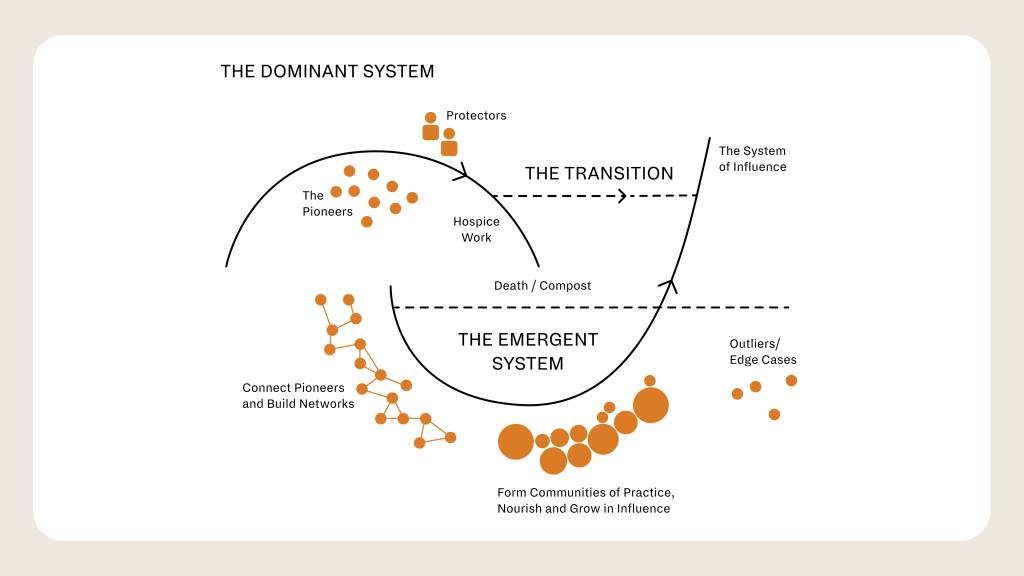
Margaret Wheatley and Deborah Frieze at the Berkana Institute came up with a theory of change I’ve returned to time and time again: the two loops model. It states change doesn’t happen like a jump cut – one narrative ending and another immediately beginning. Instead it’s more like a gradual dissolve as one fades out and the other fades.

A diagram of the Two Loops model that illustrates whats described in the text. It shows two intersecting curves together making a larger wave - the first labelled the dominant system, with The Pioneers and Protectors on it the second the emergent system. - connected with arrows.

There’s Pioneers who jump early from a dominant system to an emergent one – cell phones, the web, electric cars, fax machines, civil rights, digital video – etc. As they network together their momentum grows – and they’re supported by an equally important group who remain in the dominant system as ‘Protectors’ of these pioneers. Maybe they’re still on Substack with its Nazi-profiting owner, but they also shine light at what’s emerging and keep growing the space for it. There’s finally people who help Hospice the old system as it starts to crumble (retraining, archiving, migrating, supporting – never scolding). And somewhere along the way is a point where mass change happens.

I found a home on the Fediverse in 2017 – but I kept posting on Twitter far more frequently until Musk bought it in 2022. That was five years of living in digital disonance. But that jump was easy – I’m addicted to social media scrolling, moving to a platform with less slop is good for me. But leaving Spotify – which I’ve wanted to do since I read how they monetise AI music stolen from artists they’ve been underpaying for years – is harder. There’s so many ways I find it useful. I’m going to try to document my attempts at @leavingspotify – where the gaps are, where the things I’ve been missing have been hiding. Because I’m also tired of Spotify’s algorithm playing me the same tiny audio range of melodies that’s mostly much less diverse than my CD collection.

Call it the Digital Commons, call it the Enshitification-Proof-Web, call it Web Free, or the Fediverse, or Non-Dependent media, the Creators Web, or anything that helps us keep doing what we’re doing, while knowing there’s better ahead, and working towards it.

But platforms without stories are empty

Berkana’s theory of change could work in any direction; it could also describe a descent to totalitarianism – Pioneers pushing the edge of what’s accessible, and Protectors normalising it from the mainstream. To be free of billionaire algorithms and walled gardens alone guarantees little. We’re only as good as our stories.

Hopefully we get thru these crisis, this current throb of fascism. But the work of reminding people that the path to fascism normally starts with dehumanising – and that the cure for it lies in increasing our empathy and understanding – is never over. That much, which many of us had thought was long agreed on, is now clear. The Finish crowd-funded sensation Iron Sky about Nazis hiding on the dark-side of the moon waiting to mount a surprise re-invasion looks like almost prophetic.

Leaving algorithmic platforms can’t hurt – especially when run by a man who believes “the fundamental weakness of Western civilization is empathy“. But without stories that broaden our sense of being human, any platform, no matter how ethically run, will echo hollow.

The burden of cinema – and moving image – for those who make and support it, is that it’s perhaps better than any other medium at both de-humanising and re-humanising.

And for that, in an issue that feels like signing-off from Netribution for a while, it’s been a privelege to have been around so many blessed filmmakers.

Photo of David Nicholas Wiilkinson

David Nicholas Wilkinson: indie docmaker & distributor on keeping his independence.

He is just finishing his fifth feature documentary – 2 in 1 – driven by his experience of stage four (aka incurable) bowel cancer. The film looks at the rapid rise in bowel cancer among young people, and while we’ve known each other since Netribution was two film-degree dropouts in a trenchcoat 25 years ago, it was this subject that I reconnected with David over. My sister June died of bowel cancer in 2010, an event that saw me abandon projects and question everything for many years after. It should be released in the Autumn (disclaimer: I’m an exec producer) and it will be released for free and for fundraising. He describes it as “a film that most people will never watch… but for some small number, it might save their life… and that’s a really good way of putting my skills to good use.”

So this is kind of an interesting, um, time to interview me because in three weeks time I’ll be 70.

I also have a, you know, life-threatening illness.

And so I’m, I’ve been in a really very reflective, um, stage of mind for the last year about, you know, whether, what have I achieved through my life, what have I actually done, did what I set out to do, had, did, did that work out?

I come from, I always say working class background, but I sort of misleading. ’cause my father, who was from extremely working class background, had earned enough money to buy a detached house in a very nice part of Leeds on a private estate, but we didn’t have much money. So I did a paper round to, so only, there’s only two times in my entire life and I’ve ever been motivated by money. So I got a pound a week for six days a week. And, uh, in the course of doing that, I, the milkman approached him and he said, oh, a, he said, you are quite good looking. You should be a model. And I went, what’s that? And he said, I’ve just bought shares in a model agency in, in Bradford. And he met up with my mom and dad and we went to see this model agency and they took me on and I, I did my one and only commercial, which was for a toy called Sailor Boy, which is for my friends find really amusing, the only commercial sailor boy for a camp. It was like a hair dryer that you used to blow these plastic boats around. But from doing that, I then did Grattan’s catalog and Kay’s catalog commercials. And I used to get three guineas a day, which was a huge amount of money. I became 14 and I thought maybe I can do this as a living. And I joined a local amateur operatic and dramatic society. And then for whatever reason, I was motivated a Yorkshire television, which was one of the five big ITV companies.

They started a number of agencies in leads and I joined one of them. And within a very short space of time, I found myself auditioning for something called the Winslow Boy, which was a, a play here in, in London’s West End. And I had to have tion lessons for it. And it was that extraordinary thing that I became a professional actor within six or eight months. It was all fluke how I got found out, what happened, the say. So the agent that I went with, she wanted 25 guineas a year to join her acting course. And we didn’t have that sort of money. And when you went on the acting course, she had this big war chart and it had lots of photographs of all these people on it. And it just so happened she had a space and she put my photograph on there and didn’t cost anything. And then she sent that big war chart down to Binky Beaumont, who was at the time the West End’s biggest theater producer. And they looked to all these people on it and they went, we wanna see him. And something about my face was right for it. So there was that fluke of it. And then the other thing is that they wanted me, the producer, the director. And so Terrence Rattigan, who was the writer, wanted me. And Kenneth Moore was a star, and he never really did. And um, I started on, I was the first one to start working on it, but then they found two other boys. And because of the licensing laws, we had to all take it in turns. And Kenneth Moore sadly turned out to be a major c**t, a really, really nasty man. And he didn’t like me because I went to a secondary modern school. Now, secondary modern school means you failed. You are 11 plus, you are not very bright. They had terrible two tier system, and the other boys all went to public school. You know, they’re very top private schools and he never liked me. And so I did the out of London tour and I never got to play it in the West End. And they told me it was because my voice was breaking. And I knew that was a lie. And I always thought that it was because Kenneth Moore thought I was a bad actor. And that, that the fluke of me being found and then the way that I was treated and he got rid of me. And it was only when my father died 29 years later that it was all down to the fact that I was common. And he never thought I got rid of my Yorkshire accent, which is ironic because I speak to you now, never having had an elocution lesson for, you know, 55 years since I stopped it there. And so I never thought of acting. I, I understood the precariousness of it and I was very fortunate I was successful.

But when you start young, all the other actors you work with, they say to you, David, you’re 14, you’re 15, you’re 16. Don’t take it seriously.

Luckily I started at the bottom having done these wonderful plays. I I did the Winslow Boy again on tour with Richard Todd, who was a man who was nominated for an Oscar and was a much bigger film star than Kenneth Moore. And he had no problem with my, with me or anything about me. But I then went to Harrogate in Rep and I learned everything from the bottom. But I was so acutely aware that people would say, it’s not really a profession that you can take seriously. And everybody gave me examples of people that had been very good in things and couldn’t get work. For instance, there was an actor who was truly brilliant every just before me about 5, 6, 7 years before me. He was in Oliver Twist, which was in the same theater as the Winslow Boy. And everybody said, there’s this brilliant actor, absolutely the best art for Dodger ever, but now he’s grown up and he can’t get any work. And I said, what’s his name? And they said, Phil Collins. And I said, what’s he gonna do? And he said, well, he really wants to be an actor, but nobody will employ him. So he is gonna start a band. And, um, Phil Collins became very successful.

But, so it’s a sort of everything in this business. Everybody goes in it with a set idea of what it is. The, the advice I’ve been given by a great many actors is find another job and do that the same time as acting. And, and so many actors I know have a second job during the late seventies and eighties and nineties, that second job became voiceovers. That became huge. Mary Margolis, who’s a very good friend, and she was only like quarter of a million pounds in like the eighties. She was like the number one woman for doing it. But I never got into that and producing became the thing I thought I would want to do. And I optioned a book called Porter House Blue, which I thought would be brilliant. And I, I failed miserably to make it. I lost all my money I’d made as an actor and I did very well as an actor. And eventually got made as a television series and it won lots of BAFTA awards and it starred David, Jason and Ian Richardson.

And I’d got Donald Pleasence and Denholm Elliot, but I just couldn’t get it off the ground. I didn’t know what I was doing.

I became quite by accident the first ever independent producer to work with the BBC. And it was on a, a film, a television film of Virginia Walls to the lighthouse. And I was originally going to play one of three parts. And when the BBC found out, ’cause I I played some nice parts of him. So I, I played the lead in something that Mike Newell had directed and Ian McEwen had written, it was the first thing he’d ever written for the screen, which I got, I got 75 pounds for doing and 125 pounds for in expenses. That’s 200 pounds. It was a week’s work, it was a very, very good play. But that’s how, and even even then, 75 pounds, it was, I think the national average wage at the time was probably 50, 60 quid a week, something. So you never got that much as an actor. So I was going to play one of the parts and the BBC said, oh, I said, that’s why you’re doing it. I said, no, no, I really want to be a producer. And so I decided not to do it. And we cast an unknown actor I’ve never heard of since called Kenneth Branagh and the part, and, uh, I never thought about acting a gay. And if anything, that was my, my big mistake. And it’s funny how it turns out, I mean, I I was a useless producer. I think I have an instinct about what will work absolutely with Porter House Blue. I had the right idea with to the Lighthouse, which was somebody else’s project, but I found it and ran with it. But to be a successful producer, you have to be absolutely totally ruthless. You have to lie and you have to lie all the time. You have to lie to investors. You have to believe they’re going to get their money back. And this is the truth that nobody ever discusses. Most films will never get their money back. And it’s a terrible realization. And it took me 25 years to really face up to that. And, you know, I’ve distributed now well over a hundred films and just two or three of them have got their money back. And two of them happened to be my films. And they were made for so little. So that’s why there’s an awful, you know, France and Germany and Scandinavia and things. They, they have big subsidized and there’s not only subsidized schemes on a government level, you get support in France. Every third thing film, I think that goes into a French multiplex has to be French. Here. It’s not the case. And everything that’s shown, every French film shown in the French cinema is bought by two different broadcasters for decent money. So it’s a very healthy society.

So it was a, you know, it took me a long time to realize, but you, you have to lie. And I never could. I did once I did a film with Lenny Henry and Pete Postlethwaite which was a television film, and somebody I knew had sold his company for 70 million in Yorkshire, he put up a hundred thousand for it. And he lost every single penny. But, and I felt really guilty about that. And o only towards the end of his life did I find that he was able to offset that against profits in another area. I’ve always loved the business, but I’ve found it very difficult to make a living. And it, it was constantly looking at ways of what to do. And I always wanted to get into documentary because I came from drama. Nobody would take me seriously.

The biggest mistake I made of my life was not continuing acting. People like Mike Newell, who I worked with in John Irving, who went on to be very successful directors, when I would bump into them in the street of somewhere and they would say to me, David, why did you stop acting? But if I’d put the energies and efforts into acting that I put into producing distribution, I, I would’ve gone on more. And I turned down some really brilliant parts, the best television director that this country’s ever produced called Alan Clark. And Alan wanted to me to be in something called Bar with David Bowie. And he insisted I go and have a meeting. He’d offered me a job years before and I couldn’t do it. It it liked what I did. And I had a meeting at the BBC and I said, Alan, I don’t want to do it. And nobody’s taking me seriously as a producer, that was a huge mistake. A I would’ve worked with David Bowie and might have got to know him, and who knows, I could’ve got him for a film, but he was also bloody good production with this brilliant director. And I realized after about 10 years that I’d made a big mistake and I tried to get back to acting and I couldn’t. So after 10 years had gone by, I was desperate to try and find something. And I was doing like the thing that Anthony Hopkins directing for me, Dylan Thomas returned Journey. It was a really bonkers production. And we made the whole thing for 48,000 pounds. And, you know, and I got three grand and Tony got three grand and my fellow producer got three grand and it wasn’t a way to make a living. And so I drifted as I was lost looking for things to do, and I realized I didn’t have what it made to be a type producer. I didn’t have that ruthless, nasty streak. And so I became quite good at distribution and I started distributing my own films. I did distributed a documentary on me called James Herriot’s Yorkshire, which was very successful financially.

And I thought, oh, I know all about distribution now. And I didn’t, I was an idiot. I thought I knew it all. And I never had a film as successful of that, that grossed about 15 times its budget that was on video, the old video. But you have to pay the, the store take 50% of the money and the replication and you had to pay VAT and all of that. But the investors and everybody that worked on it, we all got it, went into profit.

I I raised the money. It took me four years to raise the money. Nobody believed it would be a success. And I, I was very fortunate that Christopher Timothy, who’d played James Herriot in the television series, was my business partner on it. And Chris worked really hard to make it happen. But we, we invented this whole new market of sort of special interest video. It became the very first one. And I remember when I went to Chris and I went to see WH Smith’s in Swindon and they said, it’s fantastic what you are doing, but you should know David and Chris ’cause they knew we were using some of our own money that we’re going to give you an order for 200 copies and we don’t think it’s going to sell. We, we said, if you are very, very lucky, if you are really lucky, it’ll sell 5,000 units. But they didn’t understand the market. And I’d spent four years understanding the market and I, I knew it would sell to tourists. I had a man that sold walking sticks and maps and he was going to distribute it. He was gonna take it around all these cafes, um, little news agents, gift shops and things. We sold 9,000 in the first week and we sold 22,000 in the first month. And we couldn’t replicate enough if, if I released it in October. And by Christmas it had all sold because it became a perfect Christmas present. And Chris and I, this is, this is being absolutely honest, if I’m being really, really honest, I bet 50% of the people that got that for Christmas never watched it. It was just a present called James Herriot’s Yorkshire showing lovely Yorkshire. But that then set off an industry. And lots of other people wanted me to replicate that and do it, and I wouldn’t. And they made like John Betjeman’s Britain and the Lakeland Poets and Hardy’s Wessex and Smiths spent a fortune doing this not understanding why ours was a success, because it was based on a bestselling book, which was based on a bestselling television series. And I had the star of the television series. So all those elements came together and they couldn’t understand that. They just thought anything would sell. So I got really, it was hard work, but it was also lucky. But I thought that every video and later DVD that I would release would do even better than that. And I never had anything come close. Monty Python thing I did, I did a couple of Monty Python films and they did very well, but I had to borrow a lot of money in order to pay the advance. ’cause they wanted a lot of money and I gave them 50% of the income and I had to give 25% to the man that gave me the money. So although it did, well, I didn’t get that much money myself, but it, it established me. I’d taken two Monty Python films that nobody else thought would work. Monty Python’s Fliegender Zirkus, which were made in Germany, in German, and um, yeah, but, and the Pythons then, ’cause I became very friendly with Terry Gillam, you know, they then sold them. When I showed it worked and I cleared all the music rights. It took me about nine months to clear the music rights.

So time consuming. Once that was done, they then sold them to Sony for a shitload of money. And my rights were never long. I didn’t have a long enough. But it was good because it then I then went, I’m going to go into distribution.

If you want to be a filmmaker, you have to understand distribution and you have to understand international sales because only when you can master that, will you ever succeed As a filmmaker, you might get lucky and you might make a film and it might work and it might have distributors bidding for it. But I found very few people in these 56 years that have ever been like that.

Yesterday my film, the Marbles was released. It’s my fourth film as a director. So within 10 years I’d made four documentaries.

I’m making my fifth now. And I have to be absolutely honest. People look at me, they come to the talks I do and they meet me and they go, Dave, you very successful. You know my, my last film Getting Away With Murders, which was about an aspect of the Holocaust, no one had ever covered before. The Guardian voted off the 1,284 films, released new films in 2021, they vo voted it as the 17th best film in the uk. And by default it was their number one documentary.

So it beat Summer of Soul, which won the Oscar and a BAFTA.

I could not have done any of that. I could not be here tonight with my film playing in the marbles in this cinema. But for one reason is I’m the distributor.

I understand distribution, I understand marketing, I understand exhibition, I understand production, I understand how to make a film, put it together. I understand how to finance them. And only by, and it’s taken me all these years to learn all those skills that I’m now in a position that I can exploit that for my benefit. But my films don’t make money. But I still manage to make other films because I’ve now got to the position, partly because of my age and partly ’cause of my standing. I go out and find people who are interested in the subject that I’m doing and I say, give me your money. I don’t say invest, I say donate. And that takes an awful lot of time.

So I released an Irish film for almost 25 years. All I released were British in Irish funds. And again, nobody else in the whole history of the film industry has made that commitment to either British films or Irish funds. It was a really good film. It had won lots of awards, but it came out in what’s called an Indian summer. So it was this breathtaking in September and it was marvelous the weather. And people just didn’t go to the cinema ’cause everybody was in the parks. And that meant the box office was abysmal, not just at the, the Curzon cinema, but several other cinemas. So when I went to cinemas who were interested, they said, David, it’s performed really badly or not taking it. The sales agents who were selling it around the world, they went to try and place it. And people said, but it’s done really badly and we’re talking hundreds of pounds. And I’d spent the best part of 35,000 pounds on it. It’s a very, very, very brutal industry. And I get so upset now when I’ve had grown men and women crying because their film that they’ve spent five years on and they’re just instantly fallen. And there is a stupid assumption, which I had when I went into, it’s why I didn’t start producing theater. I had produced theater when I was an actor. And I thought, no, if you make a film and it doesn’t work, you’ve got an asset and you can sell it so the investors will be well off. I’ve realized that that’s the crock of s**t. And it only really works if the film is successful in the first place. And I, I gave back my entire library of over a hundred films some years ago that I distributed and gave it back to the filmmakers. ’cause I said, there is nothing I can do in this, in this industry. Now there is no ancillary market for b and c listed pictures. Really? People would buy hundreds of DVDs every year. I’ve got thousands in my house and in my loft and everywhere the shed, and I never look at them, but people, it’s that obsession we have as human beings. They wanted to own them. And I know that people were buying DVDs, I released them, they would never watch them. And it was a sort of crazy thing. And now it’s all online and that market’s gone. But the income you get from online has never covered the sort of income that you would get from Blockbuster as a rental or via WH Smith. So that it’s totally different. But, but the process of distribution is still the same. You have a film you have to convince, first of all, you’ve got to convince the exhibitor why are they, there’s 18 films coming out this week. You can only show seven films. Why mine? You’ve got to convince somebody to review it. And my documentary came out this week and I’ve got 12 very good reviews of, which includes the Financial Times and The Guardian. There’s another filmmaker, he’s also got a documentary coming out this week. He’s got three reviews and one of them is from The Guardian. That’s all he’s got. So I understand because I built up these relationships, but my last film got 40 odd reviews.

That was a much more serious subject. And the timing on that was better than the timing on this one. It’s about convincing people. That’s all distribution is you’ve, you’ve got to persuade them why this one. And so the marketing of that is similar, whether it’s on A DVD or it’s online or it’s getting someone to buy a ticket. It’s a really complex industry in many ways, but it’s also incredibly simple. I’ve got this can of baked beans, I’ve got this film, you know, with Ewan McGregor in it. Do you want it? You know, this is it. Without distribution in any industry, it doesn’t matter what it is without distribution, nobody knows about that product.

Now any film can get out there, there aren’t really the gatekeepers. You literally go to YouTube or Vimeo and you load it up and you say to people, I’ve got this. The problem is monetizing it and making people aware of it. I mean, there are just so many films, it’s staggering. Tubi, which is owned by Rupert Murdoch has access to 250,000 films and programs.

If that is the case, it is a staggering number. And that’s the problem. You’ve now got TOD, which is basically you get a penny or 1 cent every time somebody watches your film, you give it to Tubi, you give it to Amazon, you give it to Plex and Pluto and Roku and all these channels, there’s over 200 of them in America. They take it for nothing and they give you a pittance and you hope that somebody watches it. And I’ve got films out there and I’m getting p**s poor money in. And so what you discussed is true. There’s now more films available than ever before. The trouble is how are people ever going to find them? But Tvo is wonderful because you can be on 10 platforms in the same country all at the same time. But the the income is tiny. I’ve just had a statement, you know, I’ve got like 270 quid from, this is from America from, I think I’m on 14 different platforms. That was a big mistake my going that route.

What happened is, Guy Richie, Matthew Vaughn never having made a film, decided to make a film. They got the money from people they know and they made this film and it was hugely successful. And the guy, Richie married Madonna and he became a multimillionaire and they never look back. And that’s what everybody who makes a film, they think it’s gonna be really big like lock stock. They’re gonna marry a Madonna and they’re gonna be really famous and that’s it for the rest of their lives. But the trouble is, is that most of them don’t do it. And a lot of them blame themselves. And some of them have right to blame themselves. They’ve not listened to distributors, they’ve not listened to sales agents. They’ve made films they shouldn’t have made. But often it’s just fluke as to why a film works and it doesn’t. There’s a film I released in, I went name the Year because then you can find out what it was, but roughly 20 years ago. And it was an incredibly impressive young man. And he had raised a million pounds. He, I mean this man, he’s like 21. I’ve rarely met anybody that’s so dynamic and had such a personality. He had, he had all the right ideas except one I found first time filmmakers. They’re either idiots or they know what they don’t know. And he thought he knew it all. I would later find out that they made the script on the third draft. You should never do that. That the best film I ever distributed was Lenny Abramson’s. Adam and Paul and Lenny went on his fifth film, was nominated for an Oscar and Lenny spent 18 months perfecting that script. He was in no rush to make it. And they made it on the 27th draft. And it is a work of genius. And this young man just thought, well, I’m happy with it. He should have gone to somebody like Colin VAs. Colin is a top producer, works with Martin Scorsese. He came from Scripps. He has start. He, funny enough, he produced Madonna’s film that she directed. And you go to someone like him and you say, Colin, I want you to be an executive producer. I’m going to pay you 10,000 pounds a day for five days. I want them at the beginning of the film just before we start shooting at various different stages. And somebody like Colin would’ve jumped at it, you know, 10,000 pounds a day. You would’ve got his entire expertise.

So things he learned when he was producing Gangs of New York, he might have brought that into it. You would’ve got that. That’s what it did. But because this director was insecure, he didn’t want anybody like that. And the film is all right, that’s all it is. It’s all right. I wouldn’t have released it if I didn’t think it was good. And I sold it to a broadcaster.

And the broadcaster, it paid the least amount of money I’ve ever licensed to film for. And that director and those two producers have never done another film. The the writer hasn’t done another film. And it’s a classic case of thinking you know, everything and not, not being aware of what you don’t know.

I’m almost 70 and being in the business for 56 years, I still don’t know very much. I had no training to be an actor. I had no training to be a producer, no training to be a distributor. I never learned from anyone else. No, I’ve never been on a writing course on a screenwriter. I’d never read a book about screenwriting. And I certainly never had any training to be a director. Everything I’ve learned on the job, and that’s really the stupid way to go because it’s you, you spend so much time doing it. And I was with Don McVey, who’s my DOP once, and he was doing something, I can’t remember what it was, we’re filming abroad. And he said, you don’t know that. And I said, no. He said, you are a director and you’re a producer and you don’t know that. And I said, yes, I don’t know it. He said, I can’t believe it. You don’t know that. He said, why don’t you know that? I said, because I’ve never needed to know it before and I’m employing you. And you know that. He said, but aren’t you embarrassed? And I said, why Amm? I embarrassed. I said, I’m now learning it from you. It’s gonna help me. What’s it to be embarrassed by? I’ve done all these things that he would’ve never said that himself, that I don’t know this. He would be afraid of looking like an idiot. But what does it matter? And the only piece of advice, and it’s for anybody watching this, I remember this that I’ve ever had, I got to know John Schlesinger. He’s the director of my favorite British film of all time, which is Billy Liar, which resonates with me because it’s very like my story in a way. And I got to know John before my wife did, but my wife worked with him five times. And we loved John and we spent time with him. And my kids loved him. He had a, with the money he made from far from the Mading crowd, he bought this huge house in the country and it was called Strawberry Hole, the House. But John called it strawberry bum hole. And my children used to love this. And we’d go down and state there, he was doing cold comfort farm, this television movie. And my wife’s costume designer had Miriam Margolyes and Kate Beckinsale, Joanna Lumley and Ian McKellen at Eileen Atkins, all this incredible cast. And John found out that I’d dropped Amy at Twikenham studios. So he said, oh, do get David to come and see me. I want to chat to him. So I said, oh, well, okay, I’ll go there. And he is doing a scene with Eileen Atkins and Mary Marleys whipping up this mge. And they did the scene once and then they wanted to do it again. So they had to whip up the mge and get it ready. So it was about 15 minutes while the props, people sorted this out. And John was asking all sorts of gossipy question, who’s f*****g who darling? And uh, yeah, what, what’s going on in there with all you young people? And uh, you know, it’s who, who’s a c**t now? And all that sort of nonsense. And after a bit we’d sort of exhorted this, but there was still time and I was a bit uncomfortable. So I said to John, I dunno why I said this. ’cause I, I, at this stage, I’d never thought about directing. I I got into directing purely by accident. He is uncanny how it happened. And I said, John, I said, is there a secret to directing? And he roared with laughter at this huge great laughter. And he said, of course not. And then he said, actually there is, he said, there is, he said, at least 50% of being a good director is choosing the right people in every department, every actor. He said, always choose the right least he said, and then you let them get on with what they do, you don’t interfere. And he said, if they have a suggestion, you listen to it. You don’t ever not listen. You take them seriously. You take them aside and say, please tell me it, and if you don’t like it, you don’t use it. If you like it, you use it. And then he told me this film he made called Marathon Man with Dustin Hoffman and, um, Laurence Olivier and John died many years ago now, but he said the grit came up to him and he said, um, I’m a Schlesinger. I’ve got this idea. Do you might have said no, tell me the idea. And he said, do this, do that, do that. And John went, fat is brilliant, right? Everyone, we’re doing this. This is what we’re gonna do. And John said, when the film came out, whenever people talked to him about that film, he said, at some point in the conversation, they remember this scene, how brilliant it was. And he said, it wasn’t my idea. Everybody thinks it was me. It was the grip’s idea. I’m going back to the man, the young man who had the million pounds to make the, that was his mistake. He didn’t listen to other people. He didn’t get more experienced people involved. Because more experienced people help you. Nobody wants to make a band film. They want to make your film the best they can. And I, I listen to people all the time. I mean, I, because I come from the theater and it, it sometimes drives me mad. I believe in arid core where everybody works together. And it does sometimes do my head in when people are going, oh Dave, you should do this, you should do that. And I’m going, look, I’ve already said I don’t know how to do that. And they carry on. But that’s, that’s the rules I’ve set. So I have to listen to them. And you know, sometimes they’re right, sometimes they’re wrong. Sometimes I find they’re right when it was too late, I’m watching the film and going, oh my God, they were right. I should have done that. A problem that a lot of actors have is that directors and producers don’t understand their process.

And I think it’s really important that if you are serious about being a director, even a producer, but a director, you need to go to the theater. You need to understand how an actor works out the arc of their character.

So it’s brilliant in the theater because you start at the beginning and you go to the middle, there’s an interval and then you go to the end. So you work all that out in rehearsal, even in small companies, theater companies, you have sort of two weeks rehearsal. If you’re a national theater, you could have eight weeks rehearsal. And most actors never get to rehearse very much on film. So to have a, a director who understands that, they’ll be insecure about it. Even the biggest actors, Anthony Hopkins, uh, who I helped, I mean, I gave him his chance to be director. So he and I had these extraordinary conversations about the problems he has working with, uh, directors and how they don’t understand the process.

So having done lots of things, I mean the, the great thing with Rep as an acting a SM, so I swept the stage and I, you know, painted the scenery and I had small parts and I bought the fruit and vegetables for, you know, a scene that you needed. Fresh fruit and vegetables. I did all of that. So it’s an incredibly, uh, wonderful learning process. And Harrogate was small knit community. I mean, ironically there were 47 people in the company. Now you probably have, it was very well funded. You know, if, if Harrogate has a theatre at all now probably be lucky to have 10 or 12. But it was, so we had three companies and there were three different directors on the move all the time. And we had people like Martin Shaw there and Tony Robinson, uh, would come up and do things. And John Challis, who is in a series called, um, only Fools and horses and lots of people that would go on to do great things. Um, and there’s something about doing theater. So when I directed my first film, which ironically was called the first film, proving the World’s first film was shot in Leeds in Yorkshire, for those who don’t know where it is. And I have a joke ending and everybody on the film that the DOP producers on it, the editor, everyone said, David, this is a terrible, it’s terrible.

So it comes and the credits start and then it happens. And I said, no, it’s going to get a laugh. I said, David, David is embarrassing. I mean a couple of people really tried to talk me out of it. And when it had its premier in Edinburgh, the full audience, it got a big laugh. And in most of the cinemas that it played in, it got a laugh. And those who they said, but how did you know that? How did you know? I said, because I was an actor, because I’ve been in the theater, you instinctively know what’s going to be funny and what isn’t. I’ve finished the Marbles with a MAF like that. Miriam Margolyes has a line, and in the cinema it gets a laugh. And the worry is, I know that people probably won’t laugh when they see it on television or on online or something. And I think probably with the other one, but I was making it for the cinema and I thought, well, I’ll keep it in for the cinema. So you need to learn all the time. You need to be a sponge. And if you look at anything, whether it’s science, film, you know, the catering industry, hoteliers, you know, whatever it is, transport is that any new way of working, any new concept comes from young people on the whole. And that’s a young person’s strength.

And you just need to combine that with experience and wisdom. So that’s why if I could have gone back to when that young man raised a million pounds and he’d come and ask my advice, I would’ve said Surround yourself. You come up with your ideas and you talk them with your team and you work it out together. And so somebody like a Colin Vaines or if he’d had a more experienced DOP or costume designer, whatever, it would’ve, it would’ve made for a better film. It, it’s everything. One does is experience. And, and I love it that I’m still learning and I learn from young people all the time. I learn from people of all ages. But, um, I, I think it’s when you close your mind off the, the people get to sort of in their forties, you think, I don’t need to learn anymore. I’ve learned it. And that’s when you close down.

The marbles has obviously taken me five years to make, and that’s all down to the money. It’s my putting the case why the path of marbles should be returned to Greece. They were stolen over 200 years ago and have been in the British Museum, which is very near this cinema. It’s YM so b’s the Garden Cinema in Covent Garden have taken it because it’s just a stones throw away.

And um, that’s opened. And in the course of making the marbles, I discovered I had stage four bowel cancer, which was a major bolt outta the blue. And I knew instantly I was gonna make a film. But the prognosis was bleak. I needed to know that. I mean, it looked as if I was gonna die fairly soon. Um, and I didn’t want to make it, you know, old man has bowel cancer. That didn’t interest me at all. And when I realized, so six, seven months had gone by and I thought, well, may, uh, you know, the chemotherapy’s doing well for a while, I’ll start making the film.

But I, when I had my very first chemo on the day I was sat there and there was a young man who’s 42, very fit looking. He was had shorts on and a t-shirt.

And he was with his wife and I was with my wife.

And, uh, my wife doesn’t come anymore, you know, but she was a bit bored ’cause I’m sat there having all this stuff pumped into me and she wanted to go and chat, or not. She did. And she came back and she didn’t say anything. And then when he left, she then told me and she said, well, he lives near us. He has the same oncologist as you. She said, he’s 42 years old. He, like you has stage four bowel cancer. Her, his wife is a senior nurse and he has either two or three children, I can’t remember.

And um, it’s terrible. You have no symptoms, no symptoms whatsoever.

And I thought, I cried. I actually cried. I thought this young man 42.

Um, and I thought, there’s my film I’d already researched and I found that bowel cancer or colon cancer, as they call it in many countries, is on the rise in people under 50. And I thought, that’s my film. I can use my experience to get into this story and people can see the treatment I’m having. But the story is, why is it rising on the young? And people are ignoring young people with their symptoms.

And then about six, eight months had gone by and I was with Dr. Murphy, my oncologist, and I said, look, you know, this man really gave me the idea. And I said, look, is this betraying patient confidentiality because I really would like to film him?

And uh, she said, well, no, she said, because he died three months after you met him.

And so that, that is the whole thrust of my film about what can be done. I mean, there’s, there’s the people are still making mistakes. I very much in the film, I, I want people to take control of their own health in a way that I didn’t, I have, I want to make this film, which I will give away free and I want people to see it. I mean that there is cancer in the young is going to become, you know, epidemic, particularly bowel cancer. But it, it’s seriously on the rise. So I actually think it’s probably the most important film I’m gonna make because all it needs is a few people to watch it and say, actually I’ve got those symptoms. I didn’t realize that. And they go and see their doctor and their doctor goes, actually this is bowel cancer, but it’s a stage one. I’m stage four. There is no cure for stage four. Stage one. We can cure it. And I thought that’s a fantastic opportunity as a filmmaker, I want it to be out there. People going, I’ve got bowel cancer, or I think I’ve got bowel cancer. And then the film will come up after doing a search and they can go, oh, maybe I’ll watch this. And they may watch 15 minutes and they’ll go, nah, I’ve not got it. Or they may can continue watching. I also want it for people who are living with people with cancer. And it’s already in my lifetime, it’s just grown. I mean, I’m calling the film one in two because at the moment, one in two people alive today in the first world are going to get cancer. That’s a given. And 30 years ago it was no where near that number. And I’ve got some people, they won’t say this on camera, but they’re saying to me off the record that if it carries on by a 20 40, 20 45, 20 50, not that far away, most people watching this will be alive. It will be one in one. So I consider this to be really important and it’s good ’cause I can bring my skills and I’ve shown it to two different bowel cancer charities and they’re both really very impressed with it. But it’s the gps, I’ve got a young woman in it. She was 19 when she got the symptoms. She, she was one year an adult, just one year. And they’re say, oh, got bowel cancer. It only affects people over 50. Don’t be silly. She had 13 tests over a three year period. And finally at the age of 22, they realized it was bowel cancer. By then it was stage three. Luckily they’ve caught it. They’ve had to save her eggs. This is a young woman who wants children who now has all these problems because her doctor said, you can’t get bowel cancer at 19. And other doctors and other experts said, yeah, we’re not even gonna test you for it. And because she’s under 40, she couldn’t have a colonoscopy. I mean, she comes from a very poor background, so they didn’t have the money to pay for it. So that is a film that most people will never watch, but for some people they will.

And for some smaller number, it might actually save their life.

So that, for me is a really good way of putting my skills to good use. And on that note, I better go.


The text "Reintermediation, humans over algorithms, the movement building a new web" over a photo of a large suspension bridge nearing completion, the two sides coming together.

Reintermediation: humans over algorithms, restoring the web we lost

Year 25, Issue 4.

RE
INTER
MEDIA
TION

REINTERMEDIATION

Humans over algorithms, the movement building a new web.

Disintermediation. The idea had come from eCommerce – we’d stop buying from shops, and instead get directly from the manufacturer, farmer and tailor. It’s something the web makes easy, and without fees to the shopkeeper should make things cheaper, so seemed inevitable based on our idiot’s understanding of capitalism. But the reality of eCommerce is we mostly buy from Amazon and eBay, because few had predicted how important an easy user experience is*, especially when joined with the price-lowering power that comes from being a monopoly.

The media industry then seemed policed by gatekeepers, who stood like a bouncer around the VIP area, keeping creators from audiences unless they were either connected or very lucky – and always prepared to follow the mainstream line. We thought getting rid of thius bouncer was essential – tho we later realised they were also keeping the neo-Nazis away from our kids, the angry drunks out of our conversations.

This is what I wrote in 2007, two years after YouTube had launched, and in between the launch of Netflix Player and iPlayer in the 3rd Film Finance Handbook:

“So it finally happened. After over a century of cinema, the power of moving image is in the hands of anyone with so much as a camera-phone and a web connection… The web shrinks the world: for the independent artist it removes the need for a studio distribution network… [It’s] the arrival of a level playing field, which the independent producer – long forced to compete with shelf and screen space with the major studios – has until now been denied.”

We were wrong about disintermediation: terribly, devastatingly – will our kids forgive us? – levels of wrong. We weren’t wrong because the world needed that bouncer, but because disintermediation actually brought with it something else: Monopoly Algorithms.

What had made me a believer? Well it was our experience. I’d followed school with traipsing Soho handing out CVs hoping to work unpaid as a runner at the fag-end of the 90s, to join a mountain of other CVs in a pile next to the bin. Tom and I then left our film degree after naîvely believing the guy from Enron that millions were around the corner –25 of them– two weeks before the dotcom crash. But just by using free HTML and CSS to make our website look as professional as any other media company’s back then helped us talk with the film industry as equals. Google ranked us first for ‘film funding’ and third for ‘film industry’ – a pair of dropouts!

So I assumed the internet heralded a great age of levelling, removing the gatekeepers and leading us into a meritocratic future.

But actually we were the last of that generation – almost everyone who has come after, could only do this if they signed up to a large multinational company – YouTube, Instagram, TikTok, or Twitter. Podcasts have largely survived decentralised – boosted by protocol-integration into iTunes while Jobs was still alive – but most blogs are moving to Substack and Ghost.

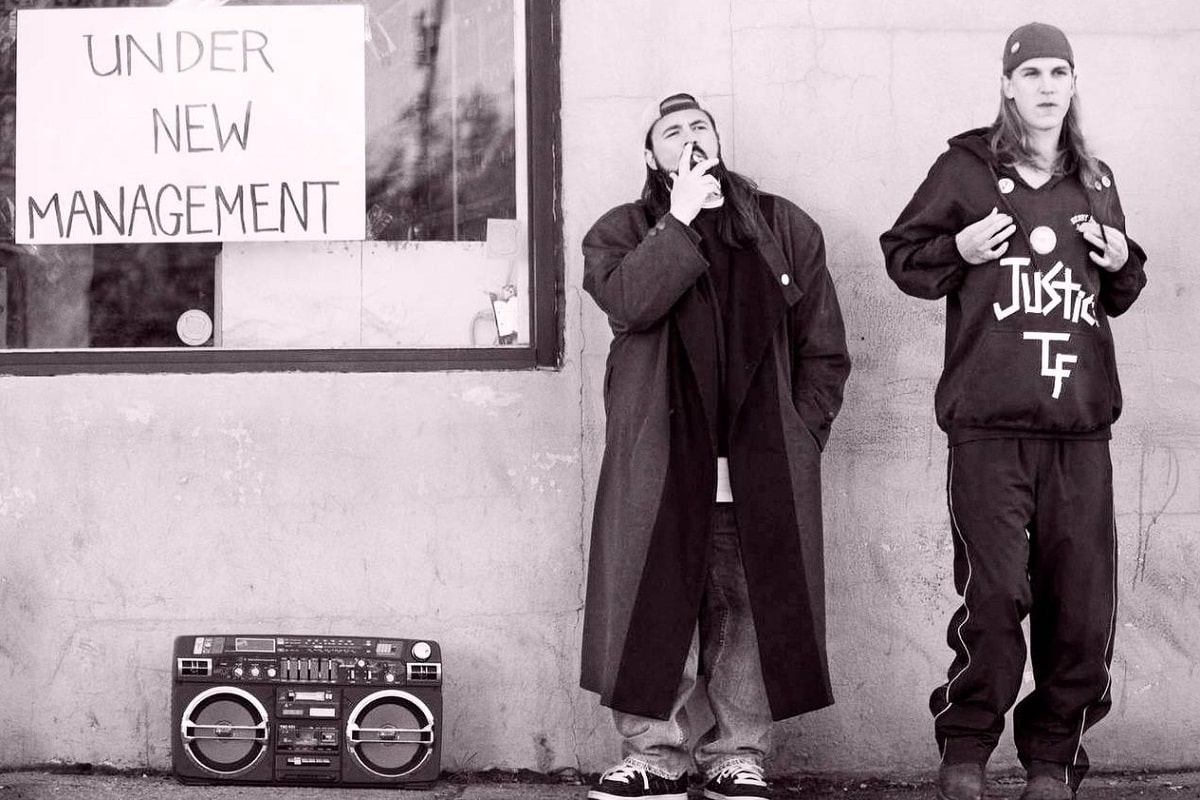
Film still from Kevin Smith's seminal 90s indie low budget film Clerks, featuring Jay and Silent Bob.

The Monopoly & The Algorithm

Part 2

So we swapped human curators for a profit-seeking algorithm.

We replaced the independent record store manager who knows exactly the right tune to play at this moment, the video store clerk who’s watched 10,000 films, the magazine racks at the giant bookstores where you could spend a day ploughing thru with a coffee.

We swapped them for some code owned by a company legally obliged to make as much money for shareholders as possible.

But most people didn’t notice because on social media they found ‘their people’, more than we find in traditional media – people with similar backgrounds, opinions, biases, and fears. Social media’s main innovation is built on grouping similar people, you enter a library or open a newspaper where everyone is a bit like you, and when they’re not, they’re presented as something other on a scale from funny weirdo to threat.

It’s hard for most people to see social media platform’s problems because they seem to be uniting your community – be that anti-racism campaigners or anti-refugee groups, pro or anti Brexit, pro or anti MAGA. But the algorithm depends on both these polorised groups to stay disunited and upset, to keep both groups engaged, and as is seen in study after study, ‘algorithmic radicalisation‘ pushes neutral, disinterested users towards these extremes.

These networks are now so entrenched – not just with users, but with creators: YouTube paid $70bn to 3 million creator channels from 2021-2023, a figure far higher than the $17bn the entire music industry paid musicians.

And of course – between the disinfo and hate radicalising – there’s obviously great things created and shared on these platforms, that might never have been seen in the old world of the big media bouncer.

But there’s still a bouncer, it’s just now a bot whose central instruction is ‘grow profits’.

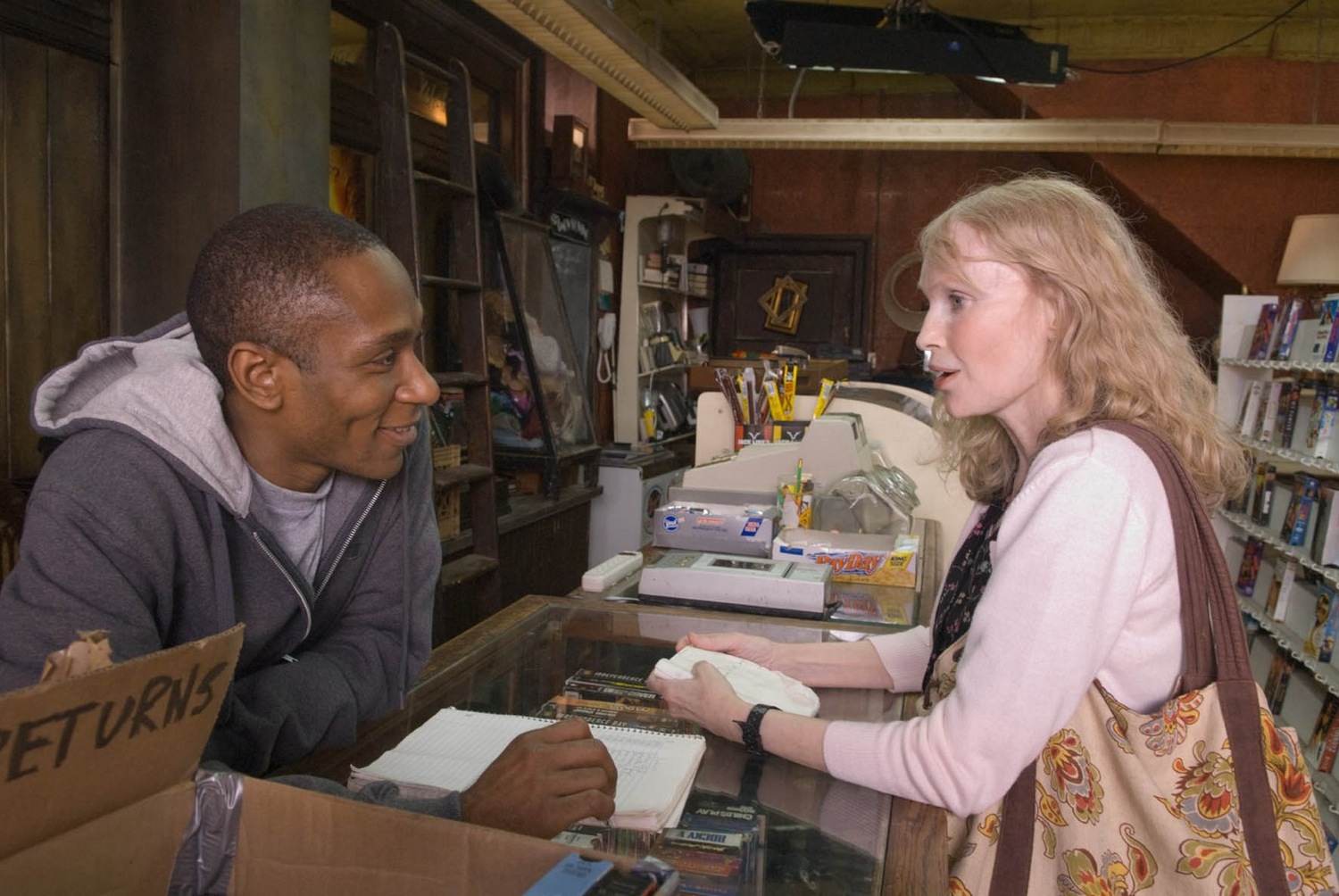
Mos Def and Mia Farrow chat over a counter in a VHS video story in Michel Gondry's 2008 film, Be Kind Rewind.

Reintermediation: restoring a middle

Part 3

What if we could bring it back?

Not the bouncer, but a place for the human curator? The specialist who can tip you 10 great albums to unwind to in the evening, or the best comedy you’ve never seen and is motivated by being good at that, rather than a giant corporation’s profit model?

Re-intermediation is the recovery of this layer at network scale. The surprising thing is there’s already millions of people developing and using a system that does this. It’s challenge is it’s still being built, so it’s often not as user-friendly, and there’s a fair chance ‘your people’ aren’t there yet. But if anything is going to bring back the best of what we’ve lost, we’re betting on this…

We live in an age of listicles – from the Sight and Sound poll to the top 25 films about eating doughnuts – yet the web never built a standardised curation layer. So unfriendly are the various gated monopolies towards each other that despite sharing an HTML foundation that was designed to connect everything everywhere – there’s not even a curation-layer monopoly. ‘The internet has devolved into screenshots of screenshots of other social media sites’ (ref) because it’s the only way we can bridge these gated monopolies.

The closest are DJ-sites like Mixcloud and review sites like GoodReads and Letterboxd. But both of these exist outside of your other media and networks: I can’t buy a song I like in a Mixcloud session; GoodReads links me to bookshops and libraries but my reviews there can’t also sit on my blog or LinkedIn. They’re inside the gate.

A real curatorial layer needs to be at a distance from both the source of the media and the player its outputted on. It’s as simple as a video store being a different entity to the video player in your house and the distributors and studio’s who’s films are in the store. We’d never consider going to a video store that only shopped films from one distributor or that only played on one brand of VHS player – yet that’s exactly the web we’ve ended up with.

VHS/DVD distribution was really competitive at four levels…

a flow diagram. Many films, arrow to Many distributors, arrow to, many places to buy or rent VHS/DVDs, arrow to Many devices to watch on.

It’s quite similar to the web’s design…

a flow diagram. Many websites, arrow to Many servers, arrow to, many ways to find (links, search, email, social, etc) arrow to Many devices to browse on.

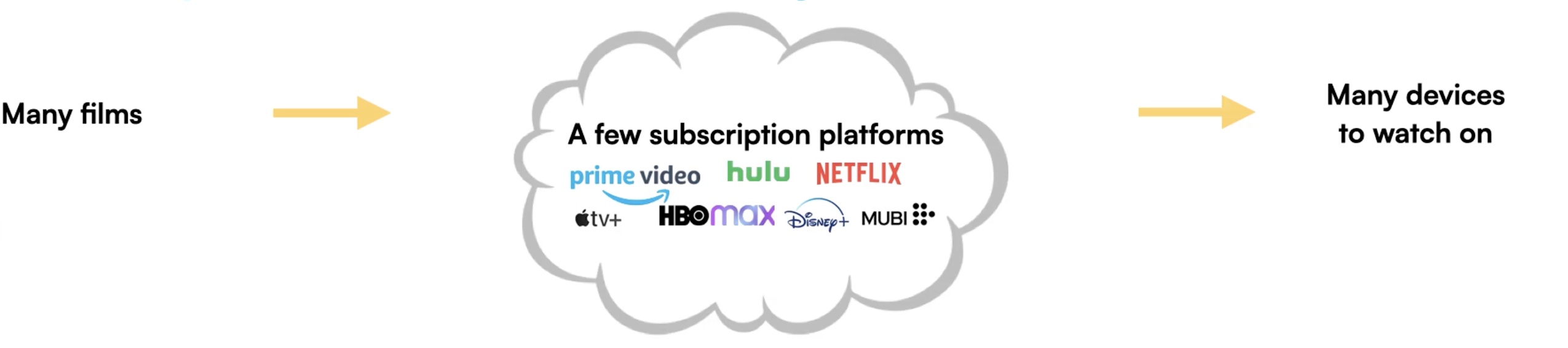
But somehow we’ve ended up with this…

a flow diagram. Many films, arrow to a few subscription platforms (Prime, Hulu, Netflix, HBO, Apple TV, Disney, Mubi), arrow to Many devices to watch on.

We’re so used to end-to-end gated media it’s hard to imagine any different. Re-intermediation is built on restoration of this separation through common standards – and restoring a curatorial layer is only one of the advantages.

A protocol-led film ecosystem that separates distributor, platform and player also supports an architecture where you don’t need to keep logging in and out of different subscription services to see media owned by different platforms – you just have your choice of player which works seamlessly with all of them. And best of all, because the player isn’t tied to one platform, the hundreds of thousands of films that aren’t on these platforms can be found…

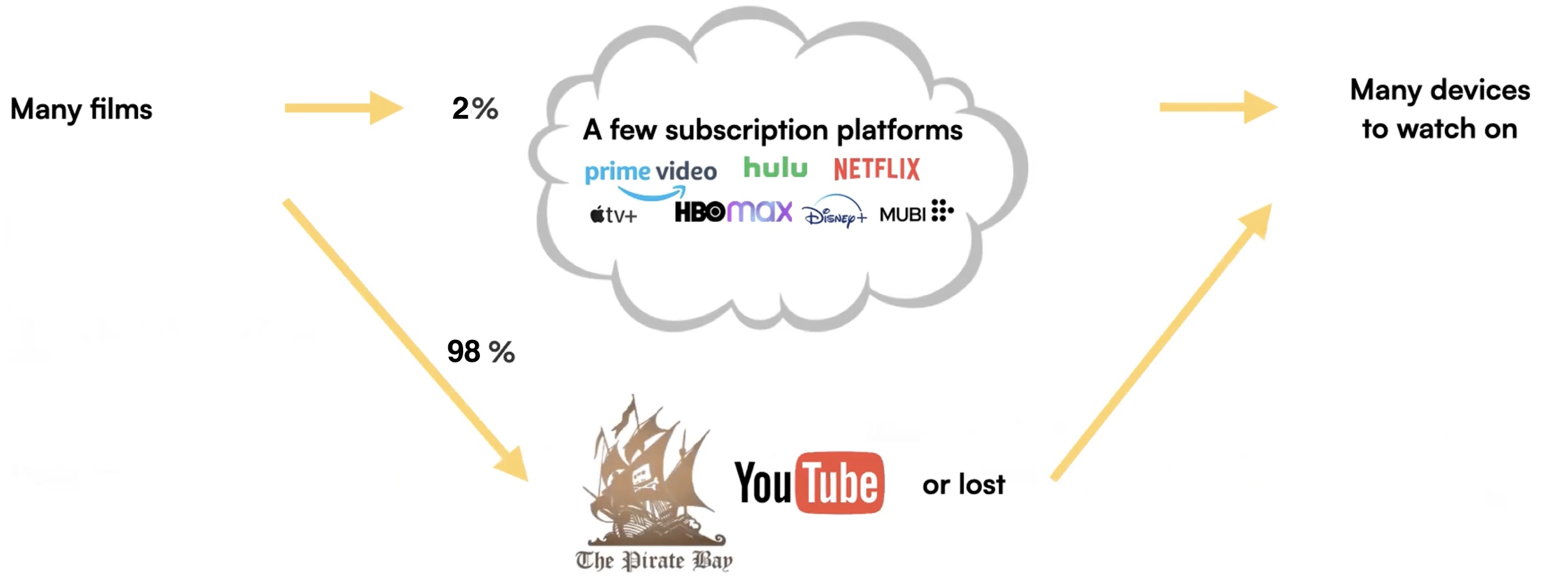
The craziest thing about how film is distributed online is 98% of films aren’t available legally…

  • 1,115,944

    Movies on TMDB

  • 70,000

    DVDs to rent on Netflix in 2007

  • 12,828

    Movies on Prime

  • 20,774

    Movies on all streaming platforms

source ReelGood, Finder

So the web distribution architecture is really…

a flow diagram. Many films, then the arrow splits, 2% goes to a few subscription platforms (Prime, Hulu, Netflix, HBO, Apple TV, Disney, Mubi) and 98% goes to The Pirate Bay, YouTube or is lost, then an arrow from both back to Many devices to watch on.

Reintermediation is about splitting that middle step in two again.

a flow diagram. Many films, arrow to Many servers & CDNs, arrow to, many was to find (platforms, portals, embeds, etc), arrow to Many devices to watch on.

Where the indie video shop was built on the VHS standard, and the indie record store was built on CD and vinyl standards – the reintermediated web is built on protocols and follows the same four steps of 20C media distribution and the web’s foundational architecture.

So the idea is to ditch the platforms that invest billions in production?

Not at all. The idea is just that they compete at each level, just as a Universal film, would show in a Warner Village cinema, and at a Blockbuster (same owners as Paramount) video store, broadcast on Disney’s ABC channel to a Sony TV. Every step of 20C media distribution had a level of competition, and this allowed for a viable and sometimes thriving independent film scene alongside the studios. So the idea is something more like this…

a flow diagram. Many films, including those from Prime, Hulu, Netflix, HBO, Apple TV, Disney, Mubi, arrow to Many servers & CDNs including those from the same list, arrow to, many was to find (platforms, portals, embeds, etc) including those from the same list, then an arrow to Many devices to watch on.

Here a Disney film might be stored on an Amazon streaming server, and play through my Netflix subscription onto my Apple TV.

At the heart of this is the idea of rights-holders tagging each of their works with a minimum price for renting, owning and streaming their film in different countries, which platforms can then re-offer to their users and subscribers.

Currently, for most rights owners Amazon Prime only pays around 1 cent per feature film play; with this model a rights-owner might say ‘our film needs a minimum 1 cent for each 10 minutes played of the film’ and only the platforms that meet that requirement can stream it – potentially even those without subscription fees who can meet that license fee via advertising (unless the rightsholder stipulates ‘no ads’).

Filmmakers get their work on all platforms without doing deals with each, and platforms have access to a far larger pool of titles. And viewers can choose the platforms and players that either have the best price, the best curation and discovery, the interface they find easiest or the community where their friends hangout and chat on. 

Photo of a bridge being built against a beautiful sky by Tatiana P on Unsplash

The Fediverse

Part 4

For over a decade, a monopoly-proof reintermediation layer has been under construction by developers and community builders across the world. It’s not yet  finished, but this so-called ‘Fediverse’ of decentralised-but-connected media networks is a facsimile of the old media separation:

  • Creation: creators create and host their work on *instances*.
  • Distribution: other *instances* boost and promote this content into other networks.
  • Playback: *Apps* help people subscribe to and engage with this content.

Some instance apps best for hosting video, photos, podcasts, music, etc, while others are best for making networks, bookmarking, sharing and chatting. Different companies, non-profits, coops and volunteer groups are involved in all of these steps making and managing an entire ecosystem of compatible services.

Don’t feel bad if you haven’t heard about it. As something that’s trying to be monopoly-proof and is driven mostly by unpaid developers, EU grant-funding and non-profits, it doesn’t employ a publicity team. Instead it’s mostly just tech people explaining all this. And tech people often describe protocols in terms of functions and capabilities, rather than the cultural impact and potential.

I hadn’t really understood it until 2022. I’d had an account on Mastodon for five years, which adopted ActivityPub in 2017, trying out a cooperative-run instance that I pay $1 a month to support paid moderators. I found I had a much nicer experience chatting with my 18 or so followers than I had on Twitter with 2,600 followers. But then in 2022 I installed PeerTube – the ActivityPub video platform – on a server in about five minutes and had an oh-this-changes-everything moment.

I’ve been trying out free and open video hosting apps for as long as the web’s been releasing them – and mostly it’s a headache to setup (the server needs to be able to handle and transcode large files, and stream them smoothly). But this was so easy to setup and use but also instantly offered something YouTube doesn’t – it could federate with other instances. Together this could make an algorithm-free space where creators could define the terms of engagement. I instantly rewrote the $100k project Netribution had been funded by the Interledger Foundation to deliver. We had to focus on this potential.

Before I explain how we did that, let me rewind a second as I need to emphasise something significant: the protocol ActivityPub powers the Twitter-ish Mastodon AND the YouTube-ish PeerTube. This isn’t the same as saying they both use the same programming language (they don’t). It’s like being able to subscribe to YouTube channels from inside Instagram, and a comment on my Instagram app shows up on the YouTube. Rather than a walled garden, ActivityPub is a network of parks.

For all of us dreaming of a world where you could watch a ‘syndicated’ Disney Plus or Apple TV show via your Netflix subscription – alongside 1000s of obscure archive and non-English films that are hard to find anywhere – this is curious heart of the Fediverse. Its goal is a web where you could bookmark your Instagram faves on your TikTok app, ReTweet your YouTube video to Facebook, buy your Spotify playlist in iTunes – while a humble blogger (or indie band or filmmaker) has instant publishing across all these spaces. It sounds crazy but it’s not really any more complex a business model than playing CDs in your DVD player. It’s a borderless social web and that’s both amazing and scary at the same time.

Introducing some of the bigger Fediverse networks…
  • Bonfire

    bonfire.social

    Communities & microblogging

  • Castopod

    castopod.org

    Podcast hosting that lets users offer paid subscriptions & a tipjar,

  • Flipboard

    Flipboard.com

    New aggregator hosting 28 million magazines

  • Funkwhale

    funkwhale.audio

    Federated audio streaming and personal music manager

  • Ghost

    ghost.org

    Open Substack alternative with paid subs, newsletters & Fediverse integration.

  • Lemmy

    join-lemmy.org

    Reddit-like communities and link aggregation.

  • Loops

    loops.video

    Short form video network from the creator of Pixelfed.

  • Mastodon

    joinmastodon.org

    The original microblogging big beast of the Fediverse – with millions of users.

  • Misskey

    misskey-hub.net

    One of the most popular apps particularly in Japan.

  • Mobilizon

    mobilizon.org

    Platofrms to share, create and join events. Think EventBrite, distributed.

  • Owncast

    owncast.online

    Open livestreaming video platform (gigs, gamers, etc)

  • Peertube

    joinpeertube.org

    Over 600,000 videos are hosted over 1,000+ Peertube instances.

  • Pixelfed

    pixelfed.org

    Slick photo-sharing app with iOS and Android apps.

  • Pleroma

    pleroma.social

    Similar capabilities to Mastodon, simpler tech. 

  • Threads

    threads.net

    Meta’s 130 million user app has a limited ActivityPub integration.

  • WordPress

    WordPress.org

    Powers 43.7% of all websites (~530m); a plugin integrates comments, subscriptions & likes.

Where this gets really confusing for newcomers is all of these, other than Threads, are open source applications – and while many have their own official community (e.g. Mastodon has mastodon.social, Pixelfed has pixelfed.social) – most people sign-up with other servers hosting ‘instances’ of these apps.

But this doesn’t matter to the wider ecosystem. A Mastodon user on a Mastodon Android app can follow and engage with any user on any Mastodon instance, if it’s not been blocked by their instance moderator, which is how moderation is handled. They can also follow PeerTube, PixelFed, Bonfire, Lemmy, Ghost, WordPress and Threads users. The interactions available vary with client and server app – but the principle is simple – use ActivityPub to support interactions between actors and objects across different servers and apps.

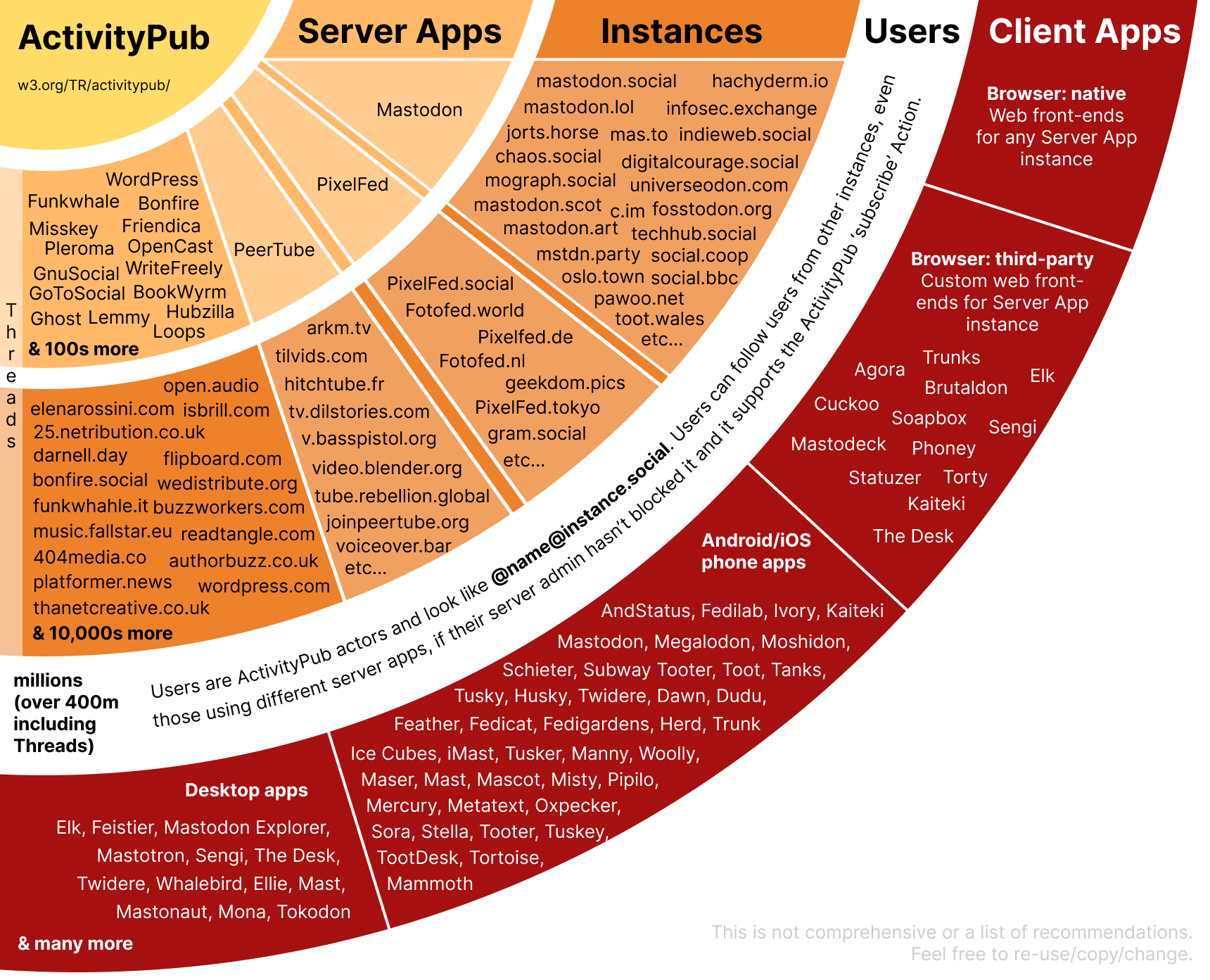
A diagram of ActivityPub and the Fediverse as a series of concentric circles - ActivityPub is at the top right, then Server Apps like Mastodon, PeerTube, PixelFed. Next come Instances grouped under each Server App, such as mastodon.social. Then is a circle explaining user accounts - taking the form username@instance.example, then the outer layer of client apps, grouped in four sections: browser, native for each server app; browser, third-party interface; Android/iOS apps and Desktop apps.

At the centre sits ActivityPub, a protocol that describes how people (‘actors’) can create and interact (‘activities’) with content (‘objects’) regardless of where they are. Different open source server applications such as PeerTube for video and PixelFed for images are hosted as instances by different groups. Users of each can follow each other – unless they’ve been blocked either at user or instance level. So there are white supremacist / X-like Mastodon instances, the instances listed above block them through a shared block list. The final step are the client apps that let users interact with their instances from their phones and desktop.

But what of BlueSky? And the rest?

Tho ActivityPub powers this WordPress site, it isn’t the only open protocol for decentralised media. Far older is RSS, which still powers the largely decentralised Podcasting world, while two other protocols – AtProto and Nostr – have growing ecosystems. XMPP, Matrix and IMAP are similar but for messaging.

In a VHS vs Betamax type protocol-split we focus on ActivityPub as it’s a W3C standard and seems less centralised. It also has bridges with both: Ditto for Nostr and BridgyFed for AtProto; apps like OpenVibe work with all 3.

  • AtProto

    BlueSky, BlackSky & NorthernSky

    AtProto was backed by Twitter co-founder Jack Dorsey after analysing the limitations of ActivityPub. It’s got some advantages, while the BlueSky app is polished with lots of features (tho no edit button), and millions of X-iles who decamped from Twitter. Rudy Fraser’s BlackSky is an independent black-community focussed AtProto project seeking autonomy from BlueSky, doing impressive work.

    atproto.com

  • Nostr

    yourspace.live, podstr.org, plektos.app, etc

    Another Jack Dorsey-backed project after he felt BlueSky too centralised. Nostr is an open protocol with privately owned ‘Relays’ – the re-intermediation layer. Its big USP is it claims to be censorship-proof, plus every piece of content is ‘signed’ making it impossible for a relay to change it and integration of tiny Bitcoin payments (‘zaps’). Growth outside of crypto-circles hasn’t happened yet.

    nostr.com

There are more users of ActivityPub enabled apps than there were web users when Netribution launched in 1999*.

*but almost all of them are on Threads

A concrete road bridge very close to completion, but getting old.

Slow down and get it right…

Part 5

We’ve been led to believe that if something isn’t an overnight success then it’s not worth bothering with. Today’s web monopolies enjoyed stratospheric growth when they arrived. Meta’s ActivityPub-aligned Threads shot to over 100 million users quicker than any app before (5 days), and in under two years has overtaken Twitter/X for active daily users. It’s bigger than the web was when Netribution launched. But the monopoly-free Mastodon hovers around a million daily active users out of 12 million or so accounts. Those million-or-so users have been static for a while, as, arguably are the communities on BlueSky and Nostr.

Some on the Fediverse are happy with this – a mountain village few wish to visit that works for its residents much more than Twitter ever did. But others want it to offer an alternative to the digital web monopolies, which means both being able to scale up moderation, and participate in the creative economies which provide incomes for millions of creators on the giant platforms.

The reality is it can be both. Federation allows mountain communities to keep protecting themselves, or build a high-speed train station (/ space port). The protocol lets each community choose the type of village they want to be, and this often varies depending on what media is the focus. If it’s music or cinema many would want the biggest library of songs and films possible; if it’s news it’s a bit larger (but not too large); if it’s opinions or blogs or social video many people want something smaller, that’s probably unique to them.

The question of how the creative industries – musicians, filmmakers, photographers, artists and writers – could make money on the Fediverse was the heart of Monetising Open Video Architecture (MOVA), the large project Netribution led in 2021-22. 

At the heart of this is the idea of subscriptions that travel with you as you browse the web and move between apps; while the media you buy online is stored independently of any cloud platform or proprietary system. It’s yours for life, just like owning a printed book, record or DVD. 

The reintermediation part is the added-benefit of allowing the human who recommends you that work of culture – DJ, librarian, film programmer or art curator – sharing some of the revenue. It sees a shift from an algorithmic intermediary for a smallish number of films on multiple competing services, to humans helping humans discover culture from a far bigger ocean of media.

This is what we looked at in 2022, and centres on a few separate concepts…

  • Open Digital Rights Language (ODRL)

    Status: a comprehensive W3C specification, but rarely used.

    Paid film distribution over DVDs and streaming platforms has been built around DRM – proprietary end-to-end software that limits what users can do. Apple originally added DRM to music sold on iTunes before ditching it so people could use other MP3 players to the iPod. The approach is designed to limit piracy, but also blocks interoperability and is frustrating for people who’ve bought media and find it deleted when the owner changes or shuts down. XBox users who bought movies on the platform – often for more than the cost of a DVD – one day found they’d been erased.

    An alternative model is a declarative rights model, where a content producer associates their media with a machine-readable license that defines what can and cannot be done with their work, and for what price. Want to release your film or album for free in the world’s poorest countries, but ask for a minimum fee to download-to-own, and a minimum per-minute payment for streaming? Copyright owners link their media with a ODRL license.

    Platforms can decide whether to be legitimate and respect these licenses, or circumvent them and risk prosecution/shutdown – exactly as happens currently (how many films can you illegally watch on YouTube if you know the link?). The extra advantage is legitimate platforms don’t have to ask before selling your work, so the cost of innovation in music or film discovery shrinks significantly.

    w3.org/TR/odrl/

  • Decentralised Subscriptions

    Status: A developed open protocol, proven in practice, but rarely used.

    What if you could have one subscription that paid multiple content providers on multiple sites? Perhaps it’s a New Music Pass – that streams payments to musicians as you visit their websites, or a Journalism Subscription, that lets you read paywalled content on 1000s of sites. Given that you only read an article or two of theirs each month it’s not worth paying for a full subscription.

    WebMonetization is a technology developed by the Interledger Foundation. Although they were founded with a $100m endowment from the Ripple Foundation – a somewhat less environmentally destructive, less criminal-friendly, yet more centralised cryptocurrency than Bitcoin – the technology works with traditional currencies and without any blockchain. It allows a browser – natively or with a plugin – to stream micropayments for every second of browser to the owner of the web page – or even the owner of the part of the web page in the centre of your screen which changes as you scroll a timeline.

    Web Monetization was the basis of coil.com, a short-lived decentralised subscription platform. That shut down in 2023, facing the combination of legal challenges and not enough users or producers engaging with the complexity.

    webmonetization.org

  • Revenue Sharing Language

    Status: A working proof-of-concept. Never used.

    When we started looking at this in 2021, the missing part of this ecosystem seemed to be the ability to define not just licenses, but revenue sharing agreements between producers, distributors/influencers and platforms – in ways that a machine and lawyer/judge could understand.

    Revenue Sharing Agreement are central to the creative copyright industries. Take the 0.4cents that Spotify pays for a play. A percentage goes to the distributor and the publisher, and maybe the record label. Of what’s left a share might go to the composer, and then marketing and recording costs are often recouped, before some kind of split between band-members. Every musician will have a different deal, and often the money earned is so small that it’s not worth paying an accountant or Collecting Society to calculate and handle distributions.

    We wanted to automate this and make it as cheap as possible to run. Revenue Sharing Language was Netribution’s proposal – a machine and human readable language for creating a range of recoupment agreements. We built a user-friendly Javascript tool to create the agreements and a system to automate payouts from a digital wallet as new income is received. It worked! But then we learned about the financial regulations surrounding handling payments from and to people you don’t know, and stopped.

    Furthermore, in the Fediverse and Creator economy age, payments could be split with people who promote work, who remix it, who choreograph it. The payouts are often so small it’s not worth splitting – but if it’s automated and free/low-cost then a £5 royalty can be split precisely.

    revenuesha.re

  • Lists, lots of lists

    Status: We’re barely even talking about this one.

    A ‘Christine Columbus’ uploads a Harry Potter film. Am I sure they’re the owner of the film as I stream them micropayments from my Fantasy Film Subscription? What if I want to find other wizard films? What if I’m 12 years old and want to watch Mr Wizard’s Wand without realising it’s adult content – bringing my platform owner into legal jeopardy – and exposing me to something certified 18?

    At the moment there’s no platform-independent architecture for creating lists of content with specific information attached. Some exist around CSEAI/CSAM/NCSI – PhotoDNA is a Microsoft-operated non-profit list of CSAM image fingerprints – to help platform moderators report and block the worst kind of video and photos.

    Mastodon has lists of servers who meet the community governance proposals and servers who’ve been blocked. IMDB and TMDB have metadata on millions of films; OMDB and MusicBrainz has data on millions of tracks; DOI has metadata on millions of academic articles.

    We built our own protoype – MOVA – to fingerprint videos using a new algorithim called the ISCC, then attach ownership, license and other verifiable metadata to the fingerprint. We tried to make it as decentralised and open as possible using another new system called Holochain, a process which helped clarify the scale of the challenge for doing this with video in a legally and morally sound way.

    A simple example: one person makes a list of LGBT-friendly films; in Russia they’re illegal, in Afghanistan watching them can sentence you to death. Lists can add functionality, but they can also facilitate corporate and and state censorship –and worse– when combined with fingerprinting. The European Commission are funding something similar to MOVA – CommonsDB – to help flag unlawful takedowns of public domain world, and potentially block AI training model use.

    There’s potentially an infinite number of possible lists. From our perspective, the minimum required list, beyond blocking illegal abuse-material – is to be able to reliably verify that payments for a piece of media are going to the right person or legal entity. Who has the right to earn from it?

We developed three projects using and inspired by these ideas:

  • Open.Movie – our PeerTube instance – ran for a couple of years and earned around £20 from coil.com Web Monetization decentralised subscriptions. But after we never had much engagement from an documentary streaming experiment at MozFest 2023 where every attendee was given £5 free to spend as they browsed, coil.com shut down not long after. The hosting costs were much higher than we could expect to bring in from decentralised subscriptions or micropayments and we shut the site down.

    Update: in Feb 2026 we brought it back on a £6/month hosted, managed shared-server in Germany for the video interviews for the final issue.

  • mova.claims logo

    mova.claims – this working prototype is by far the most complex thing I’ve been involved in making. It’s a slick Mac/Windows/Linux app, built by decentralised-specialist designers (Scuttlebut, Holochain) Sprillow – that let people associate metadata with their films, and make verifiable claims about that metadata (ownership, award wins, carbon neutral certification). However the legal liability of distributing media metadata unencrypted made it almost impossible to build a sustainable project on it. This helped clarify the limits of decentralised databaases when trying to build a project that depends on scale and legal reliability.

  • Revenue Share logo

    revenuesha.re – is built on markup language (RSL) for revenue sharing agreements and will be used in our forthcoming Carnal Cinema book. Cascade, is a user-friendly interface for producing RSL agreements, and we built CiviCRM extensions for implementing them. However, to take RevSha.re further we’d need to develop a business around it, and the financial regulations around taking money from strangers, keeping it, then distributing it is so close to the functions of a bank that it’s not a straightforward project to experiment with.

Netribution’s history starts with arriving too early – our first website was designed to be a place to watch films, but most web users then had dial-up modems and struggled to get large photos to load on the screens, let alone movies. With Netribution 2.0 we were in sync – with our “Imagine a newspaper written by its readers” document coming ahead of the rise of social media. These two experiences give two different reasons for caution: having the right idea at the wrong time; and having an incomplete idea at the right time.

The technology for a different kind of web has been built, but the systems within it to scale and provide an income for creators and moderators hasn’t yet. Furthermore, the tools to scale community-led decision-making as the number of users scales isn’t there yet. A different kind of web media can’t just be the powerhouse for the techies who know how to navigate a code environment to change things. As a result I’m not presenting this as something happening right now that will arrive in the next six months; I’ve been saying for a while it will take the rest of the decade. There’s also a chance it doesn’t happen at all.

*with every failed Internet revolution, surprisingly often the culprit is ‘didn’t predict how important an easy user experience is’. Likewise with every breakthru and birth of a giant, there’s often a leap in the user experience.…

Google’s biggest selling point when it first arrived was that most of it’s home page was white. It just had a logo and a search-bar and two buttons (search and ‘I’m feeling lucky’) plus a tally of how many pages indexed, at a time of over-cluttered website. There weren’t even ads on the results back them (how will they fund themselves? we foolishly pondered).

Facebook introduced Ajax, a technique that let you update just a small part of the page after interacting with it, rather than re-loading the whole thing. Before them clicking a ‘like’ button reloaded the entire page to update the count of likes – Facebook reloaded only the count – a tiny barely perciptable thing that made it nicer to use than MySpace.

iPhone introduced pinch and zoom for web browsing. Twitter forced people to write succinctly. Instagram solved the problem of aligning landscape and portrait photos on a feed by forcing square pics on everyone, which work just as well whether you’re on a portrait phone screen or landscape desktop computer. TikTok kept videos short and in the same portrait mode people hold their phones.

Each of these platforms did something that made life easier for users. And that’s probably why many people are going wild over AI – not because it reliably produces better quality work, but because it’s so much easier to use than us humans.

A bridge being constructed - sunrise behind it. Pillars stand out of a mass of water, a crane is silhouetted.

Let’s take it to the bridge…

In conclusion

Netribution 1 launched at the end of Web 1. Netribution 2 launched right in the middle of Web 2.0. This year of issues to celebrate Netriibution’s 25 years is coming ahead of a Web of Third Kind that, I think, seems inevitable.

It just might be a few more years away yet. Or I might be wrong and the monopolies face neither state nor market incentive to do anything differently – no ‘killer’ Fediverse app emerges, and users keep doom-stroking exactly where they currently are.

But maybe not. So we wanted to let you know, faithful reader who’s got to the end of this, where we think things are heading.

Continue reading