Instead, is the heart of the Wenders vs Roy row not an older debate about how an artist should display their politics: on the sleeve or under the vest?
Do we want the overtly political cinema of One Battle After Another, the implied, less obvious and more allegorical politics of Sinners, or the universal ‘politics’ of love and loss in Hamnet that helps us see what we all have in common?
I don’t think it’s ever been either/or. Cinema, like any artform is all of these things. We get lost in rules on how to ‘express’ politics when it comes to picking a side in a social media culture war. Any artform can boil down the biggest ideas to a still-true microcosmic-expression of it. But rather than a few seconds of passing viral attention demanding zero ambiguity as it fights to win at The Algorithm, cinema takes people on a phone-free journey in a dark room to a more complicated place, releasing them a few hours later –very occasionally– as changed people.
When the medium is a billionaire’s algorithm…
The bigger question for me around politics in art, relates to the platforms we use. If the medium is the message, how do we discuss politics when the medium is now a billionaire’s algorithm?
Our boolean age forces us into a this/that binary – pick a side, and fight it. It’s the first power system I can think of that actually wants us politically expressive, and the more extreme the better. To the algorithm this is content where extremism is more likely to catch attention, encourage encouragement, more eyeball-coin. But to us it’s fundamentally important stuff, the basis of what we believe is right and wrong, the decisions we make, that shape us. The platforms almost force us to either become apolitical or caught up in unfollowing, cancelling, defriending – cutting the perceived tumours away. That’s not new – Lord of the Rings to the Potterverse tapped into simplistic Christian-type good/evil binaries, but now, without a common religion to tell us right from wrong, and a perception of hypocrisy across conventional liberal institutions, we’re left with the billionaire’s algorithms monetising multiple sets of competing ‘moralities’.
But these algorithms have no moral compass beyond increasing their owners’ power and wealth.They care just that we’re malleable and glued to their daily content hose. Multiple sides pointing at each other convinced the other is their enemy helps that. Outrage, horror, sadness – this is monetisable energy; increased attention = more money.
This confounds us when it comes to responding. We’re now on a second Trump administration, not the first. Rallying cries push one side of the pendulum a bit, but ‘the other side’ seem to then push back at some point with similar force. The algorithms thrive on it, and while the pendulum swings back and forth we never really look long at who’s holding it. To be clear: what I’m saying doesn’t mean don’t vote or stop rallying – but that it alone isn’t enough.
The oldest trick in the book…
Non-billionaire fighting non-billionaire is the same age-old tactic feudal barons, dictators and tyrants have always found to keep us distracted from looking at whatever it is they’re stealing.
It’s not new, and it’s happening again with AI; the anti-AI and pro-AI voices are focussed on arguing with each other, not the billionaires who just stole the sum total of digitised human output –from our private messages to every book, song and film ever recorded- to train planet-burning models we’re bizarrely told will replace us unless we start using them all the time.
Which leaves the question if there’s anything more urgent politically than the question of our platforms? It’s not that the billionaire’s own them – if they own your TV or video camera you can still use it to shoot any story you want. It’s that they control the timelines we scroll for hours a day that filter and nudge our experience and understanding of reality.
Are we in too deep?
I write this on my Apple laptop. It will be hosted on infrastructure maybe owned by Amazon and Google somewhere. As we show in this issue, WordPress, which publishes this, have treated its co-founder pretty coldly. Modern life makes daily hypocrites of us all. But just because we all have a million and one reasons (or even followers) why we can’t change platforms doesn’t mean we have to surrender to apathy or indifference.
Because digitally, we can also exist in multiple places at once. We can use what we have to use for practical reasons, “render unto Caesar the things that are Caesar’s” while also “working as if you live in the early days of a better” world (Gray). Compromises don’t prevent us from hope, on the basis that it will have to happen sooner or later – that view of Dr King that “The arc of the moral universe is long, but it bends toward justice.”
Digital dissonance as a strategy…
Margaret Wheatley and Deborah Frieze at the Berkana Institute came up with a theory of change I’ve returned to time and time again: the two loops model. It states change doesn’t happen like a jump cut – one narrative ending and another immediately beginning. Instead it’s more like a gradual dissolve as one fades out and the other fades.
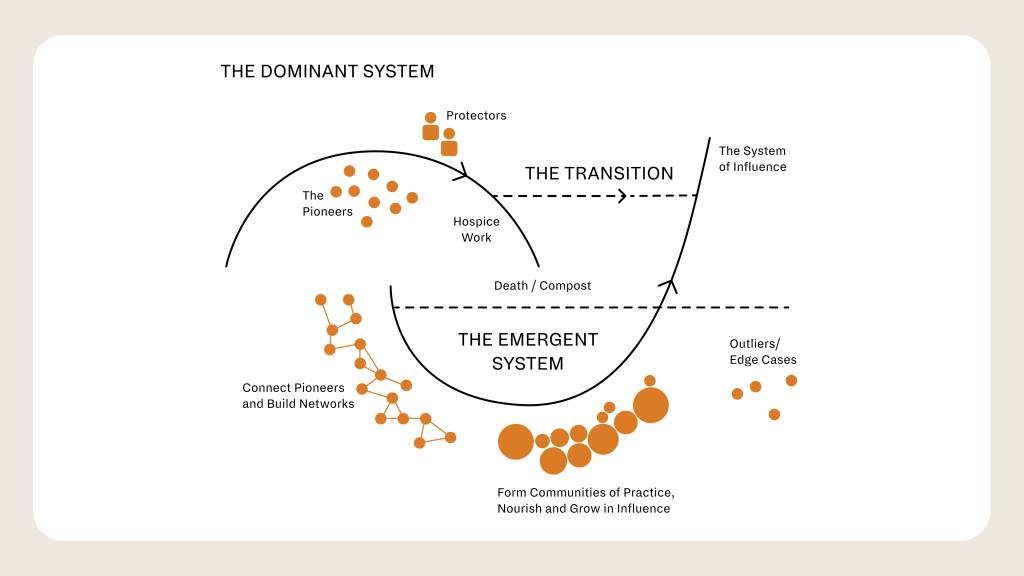
There’s Pioneers who jump early from a dominant system to an emergent one – cell phones, the web, electric cars, fax machines, civil rights, digital video – etc. As they network together their momentum grows – and they’re supported by an equally important group who remain in the dominant system as ‘Protectors’ of these pioneers. Maybe they’re still on Substack with its Nazi-profiting owner, but they also shine light at what’s emerging and keep growing the space for it. There’s finally people who help Hospice the old system as it starts to crumble (retraining, archiving, migrating, supporting – never scolding). And somewhere along the way is a point where mass change happens.
I found a home on the Fediverse in 2017 – but I kept posting on Twitter far more frequently until Musk bought it in 2022. That was five years of living in digital disonance. But that jump was easy – I’m addicted to social media scrolling, moving to a platform with less slop is good for me. But leaving Spotify – which I’ve wanted to do since I read how they monetise AI music stolen from artists they’ve been underpaying for years – is harder. There’s so many ways I find it useful. I’m going to try to document my attempts at @leavingspotify – where the gaps are, where the things I’ve been missing have been hiding. Because I’m also tired of Spotify’s algorithm playing me the same tiny audio range of melodies that’s mostly much less diverse than my CD collection.
Call it the Digital Commons, call it the Enshitification-Proof-Web, call it Web Free, or the Fediverse, or Non-Dependent media, the Creators Web, or anything that helps us keep doing what we’re doing, while knowing there’s better ahead, and working towards it.
But platforms without stories are empty
Berkana’s theory of change could work in any direction; it could also describe a descent to totalitarianism – Pioneers pushing the edge of what’s accessible, and Protectors normalising it from the mainstream. To be free of billionaire algorithms and walled gardens alone guarantees little. We’re only as good as our stories.
Hopefully we get thru these crisis, this current throb of fascism. But the work of reminding people that the path to fascism normally starts with dehumanising – and that the cure for it lies in increasing our empathy and understanding – is never over. That much, which many of us had thought was long agreed on, is now clear. The Finish crowd-funded sensation Iron Sky about Nazis hiding on the dark-side of the moon waiting to mount a surprise re-invasion looks like almost prophetic.
Leaving algorithmic platforms can’t hurt – especially when run by a man who believes “the fundamental weakness of Western civilization is empathy“. But without stories that broaden our sense of being human, any platform, no matter how ethically run, will echo hollow.
The burden of cinema – and moving image – for those who make and support it, is that it’s perhaps better than any other medium at both de-humanising and re-humanising.
And for that, in an issue that feels like signing-off from Netribution for a while, it’s been a privelege to have been around so many blessed filmmakers.

Leave a Reply