This is a trailer I made back in 2020 for a documentary I wanted to make about Open Source, before getting distracted actually making open source things. It opens with one of the two interviews I did for it with Donald Lobo, co-founder of CiviCRM, which he both built and funded thru his earnings as employee no. 5 of Yahoo. He’s a good example of a BDFL who stepped down where the community stepped in successfully.
Donald Lobo: What is open source and why the hell should I care about it?
Archive: Writing this program in BASIC is your next assignment.
Steve Jobs: If you look at the technological revolution that we’re all in, it’s a process of taking very centralized things and making them very democratic, if you will. Software CEOs. Could I please ask you to introduce yourselves?
Bill Gates: My name is Bill Gates. I’m chairman of Microsoft.
Archive: This is the rarest of birds. A game you can load on your hard disc because it’s not copy protected.
Archive anti-piracy advert: Piracy fund terrorism. Don’t touch the hot stuff.
Chris Anderson: This Is the Linux World headquarters.
Linus Torvalds: Um, yeah,
Chris Anderson: So your software, Linux powers much of the internet. There are billions of active Android devices out there. Your software is in every single one of them.
News-reader:Jenny, You have said that this is a transformational deal, that this is something that is a game changer for IBM.
Satya Nadella: We are all in on open source, and that’s what really brings us together with GitHub.
Clay Shirky: A momentous thing that can happen to a culture is they can acquire a new style of arguing trial by jury, voting, peer review. Now this, a programmer in Edinburgh and a programmer in Tebet can both get the same, a copy of the same piece of software. Each of them can make changes and they can merge them after the fact, even if they didn’t know of each other’s existence beforehand. This is cooperation without coordination. This is the big change,
Archive clips: And our goal was to create an open source ventilator. It started a week ago and already we’ve organized a thousand different volunteers, engineers, designers, medical professionals, So the face masks are an open source design. We had the facilities producing these on a large scale, so we searched online to find the existing designs
Clay Shirky: Out of this community, but using these tools, they can now create something together. It’s large, it’s distributed, it’s low cost, and it’s compatible with the ideals of democracy. The question for us now is, are we gonna let the programmers keep it to themselves, or are we gonna try and take it and press it into service for society at large?
Humans over algorithms, the movement building a new web.
Disintermediation. The idea had come from eCommerce – we’d stop buying from shops, and instead get directly from the manufacturer, farmer and tailor. It’s something the web makes easy, and without fees to the shopkeeper should make things cheaper, so seemed inevitable based on our idiot’s understanding of capitalism. But the reality of eCommerce is we mostly buy from Amazon and eBay, because few had predicted how important an easy user experience is*, especially when joined with the price-lowering power that comes from being a monopoly.
The media industry then seemed policed by gatekeepers, who stood like a bouncer around the VIP area, keeping creators from audiences unless they were either connected or very lucky – and always prepared to follow the mainstream line. We thought getting rid of thius bouncer was essential – tho we later realised they were also keeping the neo-Nazis away from our kids, the angry drunks out of our conversations.
This is what I wrote in 2007, two years after YouTube had launched, and in between the launch of Netflix Player and iPlayer in the 3rd Film Finance Handbook:
“So it finally happened. After over a century of cinema, the power of moving image is in the hands of anyone with so much as a camera-phone and a web connection… The web shrinks the world: for the independent artist it removes the need for a studio distribution network… [It’s] the arrival of a level playing field, which the independent producer – long forced to compete with shelf and screen space with the major studios – has until now been denied.”
We were wrong about disintermediation: terribly, devastatingly – will our kids forgive us? – levels of wrong. We weren’t wrong because the world needed that bouncer, but because disintermediation actually brought with it something else: Monopoly Algorithms.
What had made me a believer? Well it was our experience. I’d followed school with traipsing Soho handing out CVs hoping to work unpaid as a runner at the fag-end of the 90s, to join a mountain of other CVs in a pile next to the bin. Tom and I then left our film degree after naîvely believing the guy from Enron that millions were around the corner –25 of them– two weeks before the dotcom crash. But just by using free HTML and CSS to make our website look as professional as any other media company’s back then helped us talk with the film industry as equals. Google ranked us firstfor ‘film funding’ and third for ‘film industry’ – a pair of dropouts!
So I assumed the internet heralded a great age of levelling, removing the gatekeepers and leading us into a meritocratic future.
But actually we were the last of that generation – almost everyone who has come after, could only do this if they signed up to a large multinational company – YouTube, Instagram, TikTok, or Twitter. Podcasts have largely survived decentralised – boosted by protocol-integration into iTunes while Jobs was still alive – but most blogs are moving to Substack and Ghost.
The Monopoly & The Algorithm
Part 2
So we swapped human curators for a profit-seeking algorithm.
We replaced the independent record store manager who knows exactly the right tune to play at this moment, the video store clerk who’s watched 10,000 films, the magazine racks at the giant bookstores where you could spend a day ploughing thru with a coffee.
We swapped them for some code owned by a company legally obliged to make as much money for shareholders as possible.
But most people didn’t notice because on social media they found ‘their people’, more than we find in traditional media – people with similar backgrounds, opinions, biases, and fears. Social media’s main innovation is built on grouping similar people, you enter a library or open a newspaper where everyone is a bit like you, and when they’re not, they’re presented as something other on a scale from funny weirdo to threat.
It’s hard for most people to see social media platform’s problems because they seem to be uniting your community – be that anti-racism campaigners or anti-refugee groups, pro or anti Brexit, pro or anti MAGA. But the algorithm depends on both these polorised groups to stay disunited and upset, to keep both groups engaged, and as is seen in study after study, ‘algorithmic radicalisation‘ pushes neutral, disinterested users towards these extremes.
And of course – between the disinfo and hate radicalising – there’s obviously great things created and shared on these platforms, that might never have been seen in the old world of the big media bouncer.
But there’s still a bouncer, it’s just now a bot whose central instruction is ‘grow profits’.
Reintermediation: restoring a middle
Part 3
What if we could bring it back?
Not the bouncer, but a place for the human curator? The specialist who can tip you 10 great albums to unwind to in the evening, or the best comedy you’ve never seen and is motivated by being good at that, rather than a giant corporation’s profit model?
Re-intermediation is the recovery of this layer at network scale. The surprising thing is there’s already millions of people developing and using a system that does this. It’s challenge is it’s still being built, so it’s often not as user-friendly, and there’s a fair chance ‘your people’ aren’t there yet. But if anything is going to bring back the best of what we’ve lost, we’re betting on this…
We live in an age of listicles – from the Sight and Sound poll to the top 25 films about eating doughnuts – yet the web never built a standardised curation layer. So unfriendly are the various gated monopolies towards each other that despite sharing an HTML foundation that was designed to connect everything everywhere – there’s not even a curation-layer monopoly. ‘The internet has devolved into screenshots of screenshots of other social media sites’ (ref) because it’s the only way we can bridge these gated monopolies.
The closest are DJ-sites like Mixcloud and review sites like GoodReads and Letterboxd. But both of these exist outside of your other media and networks: I can’t buy a song I like in a Mixcloud session; GoodReads links me to bookshops and libraries but my reviews there can’t also sit on my blog or LinkedIn. They’re inside the gate.
A real curatorial layer needs to be at a distance from both the source of the media and the player its outputted on. It’s as simple as a video store being a different entity to the video player in your house and the distributors and studio’s who’s films are in the store. We’d never consider going to a video store that only shopped films from one distributor or that only played on one brand of VHS player – yet that’s exactly the web we’ve ended up with.
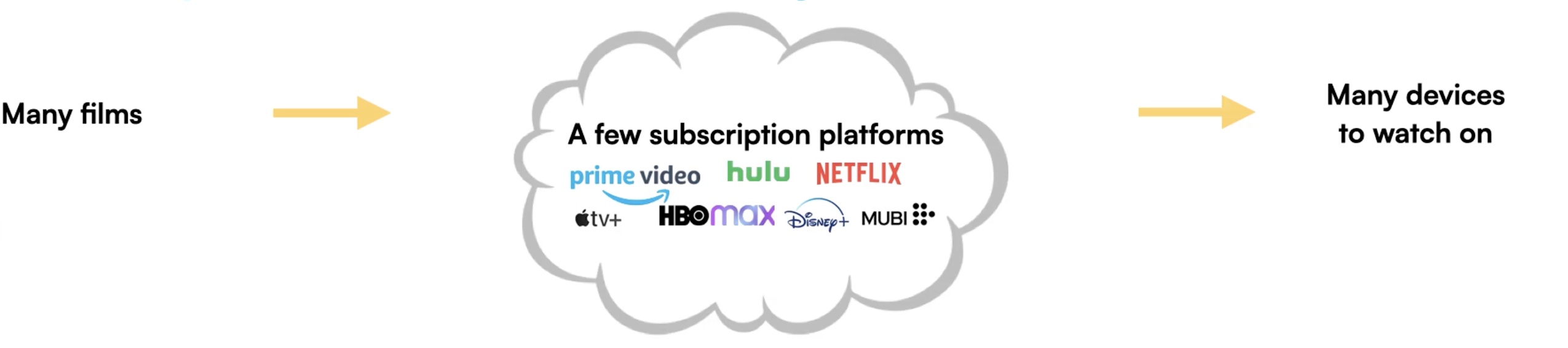
VHS/DVD distribution was really competitive at four levels…
It’s quite similar to the web’s design…
But somehow we’ve ended up with this…
We’re so used to end-to-end gated media it’s hard to imagine any different. Re-intermediation is built on restoration of this separation through common standards – and restoring a curatorial layer is only one of the advantages.
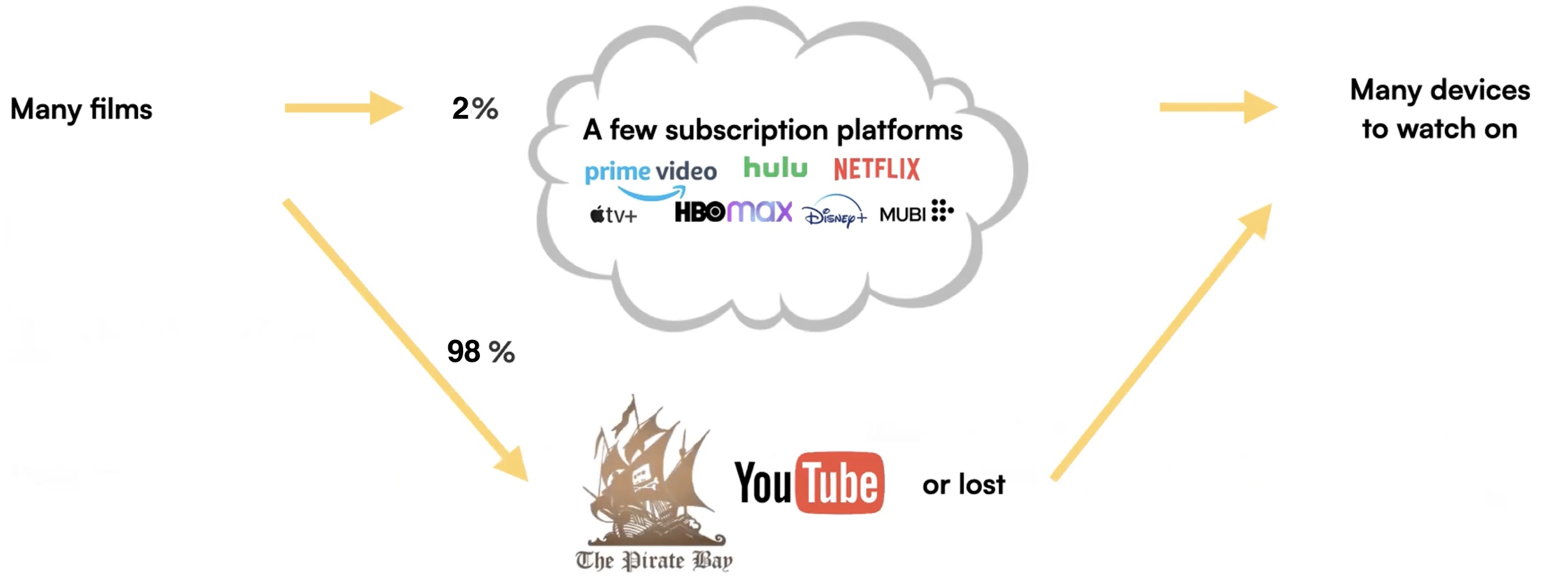
A protocol-led film ecosystem that separates distributor, platform and player also supports an architecture where you don’t need to keep logging in and out of different subscription services to see media owned by different platforms – you just have your choice of player which works seamlessly with all of them. And best of all, because the player isn’t tied to one platform, the hundreds of thousands of films that aren’t on these platforms can be found…
The craziest thing about how film is distributed online is 98% of films aren’t available legally…
1,115,944
Movies on TMDB
70,000
DVDs to rent on Netflix in 2007
12,828
Movies on Prime
20,774
Movies on all streaming platforms
source ReelGood, Finder
So the web distribution architecture is really…
Reintermediation is about splitting that middle step in two again.
Where the indie video shop was built on the VHS standard, and the indie record store was built on CD and vinyl standards – the reintermediated web is built on protocols and follows the same four steps of 20C media distribution and the web’s foundational architecture.
So the idea is to ditch the platforms that invest billions in production?
Not at all. The idea is just that they compete at each level, just as a Universal film, would show in a Warner Village cinema, and at a Blockbuster (same owners as Paramount) video store, broadcast on Disney’s ABC channel to a Sony TV. Every step of 20C media distribution had a level of competition, and this allowed for a viable and sometimes thriving independent film scene alongside the studios. So the idea is something more like this…
Here a Disney film might be stored on an Amazon streaming server, and play through my Netflix subscription onto my Apple TV.
At the heart of this is the idea of rights-holders tagging each of their works with a minimum price for renting, owning and streaming their film in different countries, which platforms can then re-offer to their users and subscribers.
Currently, for most rights owners Amazon Prime only pays around 1 cent per feature film play; with this model a rights-owner might say ‘our film needs a minimum 1 cent for each 10 minutes played of the film’ and only the platforms that meet that requirement can stream it – potentially even those without subscription fees who can meet that license fee via advertising (unless the rightsholder stipulates ‘no ads’).
Filmmakers get their work on all platforms without doing deals with each, and platforms have access to a far larger pool of titles. And viewers can choose the platforms and players that either have the best price, the best curation and discovery, the interface they find easiest or the community where their friends hangout and chat on.
The Fediverse
Part 4
For over a decade, a monopoly-proof reintermediation layer has been under construction by developers and community builders across the world. It’s not yet finished, but this so-called ‘Fediverse’ of decentralised-but-connected media networks is a facsimile of the old media separation:
Creation: creators create and host their work on *instances*.
Distribution: other *instances* boost and promote this content into other networks.
Playback: *Apps* help people subscribe to and engage with this content.
Some instance apps best for hosting video, photos, podcasts, music, etc, while others are best for making networks, bookmarking, sharing and chatting. Different companies, non-profits, coops and volunteer groups are involved in all of these steps making and managing an entire ecosystem of compatible services.
Don’t feel bad if you haven’t heard about it. As something that’s trying to be monopoly-proof and is driven mostly by unpaid developers, EU grant-funding and non-profits, it doesn’t employ a publicity team. Instead it’s mostly just tech people explaining all this. And tech people often describe protocols in terms of functions and capabilities, rather than the cultural impact and potential.
I hadn’t really understood it until 2022. I’d had an account on Mastodon for five years, which adopted ActivityPub in 2017, trying out a cooperative-run instance that I pay $1 a month to support paid moderators. I found I had a much nicer experience chatting with my 18 or so followers than I had on Twitter with 2,600 followers. But then in 2022 I installed PeerTube – the ActivityPub video platform – on a server in about five minutes and had an oh-this-changes-everything moment.
I’ve been trying out free and open video hosting apps for as long as the web’s been releasing them – and mostly it’s a headache to setup (the server needs to be able to handle and transcode large files, and stream them smoothly). But this was so easy to setup and use but also instantly offered something YouTube doesn’t – it could federate with other instances. Together this could make an algorithm-free space where creators could define the terms of engagement. I instantly rewrote the $100k project Netribution had been funded by the Interledger Foundation to deliver. We had to focus on this potential.
Before I explain how we did that, let me rewind a second as I need to emphasise something significant: the protocol ActivityPub powers the Twitter-ish Mastodon AND the YouTube-ish PeerTube. This isn’t the same as saying they both use the same programming language (they don’t). It’s like being able to subscribe to YouTube channels from inside Instagram, and a comment on my Instagram app shows up on the YouTube. Rather than a walled garden, ActivityPub is a network of parks.
For all of us dreaming of a world where you could watch a ‘syndicated’ Disney Plus or Apple TV show via your Netflix subscription – alongside 1000s of obscure archive and non-English films that are hard to find anywhere – this is curious heart of the Fediverse. Its goal is a web where you could bookmark your Instagram faves on your TikTok app, ReTweet your YouTube video to Facebook, buy your Spotify playlist in iTunes – while a humble blogger (or indie band or filmmaker) has instant publishing across all these spaces. It sounds crazy but it’s not really any more complex a business model than playing CDs in your DVD player. It’s a borderless social web and that’s both amazing and scary at the same time.
Introducing some of the bigger Fediverse networks…
Bonfire
bonfire.social
Communities & microblogging
Castopod
castopod.org
Podcast hosting that lets users offer paid subscriptions & a tipjar,
Flipboard
Flipboard.com
New aggregator hosting 28 million magazines
Funkwhale
funkwhale.audio
Federated audio streaming and personal music manager
Ghost
ghost.org
Open Substack alternative with paid subs, newsletters & Fediverse integration.
Lemmy
join-lemmy.org
Reddit-like communities and link aggregation.
Loops
loops.video
Short form video network from the creator of Pixelfed.
Mastodon
joinmastodon.org
The original microblogging big beast of the Fediverse – with millions of users.
Misskey
misskey-hub.net
One of the most popular apps particularly in Japan.
Mobilizon
mobilizon.org
Platofrms to share, create and join events. Think EventBrite, distributed.
Owncast
owncast.online
Open livestreaming video platform (gigs, gamers, etc)
Peertube
joinpeertube.org
Over 600,000 videos are hosted over 1,000+ Peertube instances.
Pixelfed
pixelfed.org
Slick photo-sharing app with iOS and Android apps.
Pleroma
pleroma.social
Similar capabilities to Mastodon, simpler tech.
Threads
threads.net
Meta’s 130 million user app has a limited ActivityPub integration.
WordPress
WordPress.org
Powers 43.7% of all websites (~530m); a plugin integrates comments, subscriptions & likes.
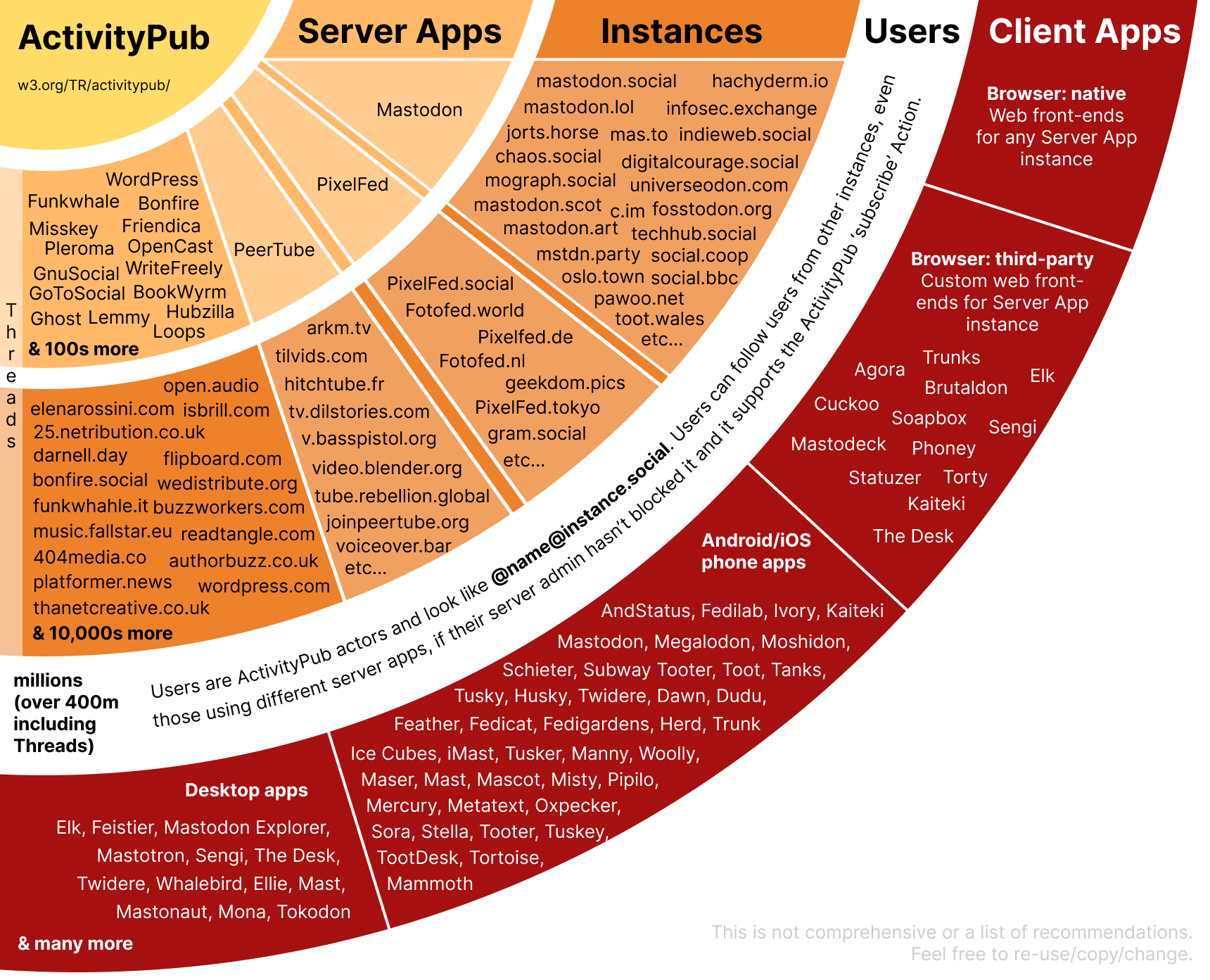
Where this gets really confusing for newcomers is all of these, other than Threads, are open source applications – and while many have their own official community (e.g. Mastodon has mastodon.social, Pixelfed has pixelfed.social) – most people sign-up with other servers hosting ‘instances’ of these apps.
But this doesn’t matter to the wider ecosystem. A Mastodon user on a Mastodon Android app can follow and engage with any user on any Mastodon instance, if it’s not been blocked by their instance moderator, which is how moderation is handled. They can also follow PeerTube, PixelFed, Bonfire, Lemmy, Ghost, WordPress and Threads users. The interactions available vary with client and server app – but the principle is simple – use ActivityPub to support interactions between actors and objects across different servers and apps.
At the centre sits ActivityPub, a protocol that describes how people (‘actors’) can create and interact (‘activities’) with content (‘objects’) regardless of where they are. Different open source server applications such as PeerTube for video and PixelFed for images are hosted as instances by different groups. Users of each can follow each other – unless they’ve been blocked either at user or instance level. So there are white supremacist / X-like Mastodon instances, the instances listed above block them through a shared block list. The final step are the client apps that let users interact with their instances from their phones and desktop.
But what of BlueSky? And the rest?
Tho ActivityPub powers this WordPress site, it isn’t the only open protocol for decentralised media. Far older is RSS, which still powers the largely decentralised Podcasting world, while two other protocols – AtProto and Nostr – have growing ecosystems. XMPP, Matrix and IMAP are similar but for messaging.
In a VHS vs Betamax type protocol-split we focus on ActivityPub as it’s a W3C standard and seems less centralised. It also has bridges with both: Ditto for Nostr and BridgyFed for AtProto; apps like OpenVibe work with all 3.
AtProto
BlueSky, BlackSky & NorthernSky
AtProto was backed by Twitter co-founder Jack Dorsey after analysing the limitations of ActivityPub. It’s got some advantages, while theBlueSkyapp is polished with lots of features (tho no edit button), and millions of X-iles who decamped from Twitter. Rudy Fraser’sBlackSkyis an independent black-community focussed AtProto project seeking autonomy from BlueSky, doing impressive work.
Another Jack Dorsey-backed project after he felt BlueSky too centralised. Nostr is an open protocol with privately owned ‘Relays’ – the re-intermediation layer. Its big USP is it claims to be censorship-proof, plus every piece of content is ‘signed’ making it impossible for a relay to change it and integration of tiny Bitcoin payments (‘zaps’). Growth outside of crypto-circles hasn’t happened yet.
There are more users of ActivityPub enabled apps than there were web users when Netribution launched in 1999*.
*but almost all of them are on Threads
Slow down and get it right…
Part 5
We’ve been led to believe that if something isn’t an overnight success then it’s not worth bothering with. Today’s web monopolies enjoyed stratospheric growth when they arrived. Meta’s ActivityPub-aligned Threads shot to over 100 million users quicker than any app before (5 days), and in under two years has overtaken Twitter/X for active daily users. It’s bigger than the web was when Netribution launched. But the monopoly-free Mastodon hovers around a million daily active users out of 12 million or so accounts. Those million-or-so users have been static for a while, as, arguably are the communities on BlueSky and Nostr.
Some on the Fediverse are happy with this – a mountain village few wish to visit that works for its residents much more than Twitter ever did. But others want it to offer an alternative to the digital web monopolies, which means both being able to scale up moderation, and participate in the creative economies which provide incomes for millions of creators on the giant platforms.
The reality is it can be both. Federation allows mountain communities to keep protecting themselves, or build a high-speed train station (/ space port). The protocol lets each community choose the type of village they want to be, and this often varies depending on what media is the focus. If it’s music or cinema many would want the biggest library of songs and films possible; if it’s news it’s a bit larger (but not too large); if it’s opinions or blogs or social video many people want something smaller, that’s probably unique to them.
The question of how the creative industries – musicians, filmmakers, photographers, artists and writers – could make money on the Fediverse was the heart of Monetising Open Video Architecture (MOVA), the large project Netribution led in 2021-22.
At the heart of this is the idea of subscriptions that travel with you as you browse the web and move between apps; while the media you buy online is stored independently of any cloud platform or proprietary system. It’s yours for life, just like owning a printed book, record or DVD.
The reintermediation part is the added-benefit of allowing the human who recommends you that work of culture – DJ, librarian, film programmer or art curator – sharing some of the revenue. It sees a shift from an algorithmic intermediary for a smallish number of films on multiple competing services, to humans helping humans discover culture from a far bigger ocean of media.
This is what we looked at in 2022, and centres on a few separate concepts…
Open Digital Rights Language (ODRL)
Status: a comprehensive W3C specification, but rarely used.
Paid film distribution over DVDs and streaming platforms has been built around DRM – proprietary end-to-end software that limits what users can do. Apple originally added DRM to music sold on iTunes before ditching it so people could use other MP3 players to the iPod. The approach is designed to limit piracy, but also blocks interoperability and is frustrating for people who’ve bought media and find it deleted when the owner changes or shuts down. XBox users who bought movies on the platform – often for more than the cost of a DVD – one day found they’d been erased.
An alternative model is a declarative rights model, where a content producer associates their media with a machine-readable license that defines what can and cannot be done with their work, and for what price. Want to release your film or album for free in the world’s poorest countries, but ask for a minimum fee to download-to-own, and a minimum per-minute payment for streaming? Copyright owners link their media with a ODRL license.
Platforms can decide whether to be legitimate and respect these licenses, or circumvent them and risk prosecution/shutdown – exactly as happens currently (how many films can you illegally watch on YouTube if you know the link?). The extra advantage is legitimate platforms don’t have to ask before selling your work, so the cost of innovation in music or film discovery shrinks significantly.
Status: A developed open protocol, proven in practice, but rarely used.
What if you could have one subscription that paid multiple content providers on multiple sites? Perhaps it’s a New Music Pass – that streams payments to musicians as you visit their websites, or a Journalism Subscription, that lets you read paywalled content on 1000s of sites. Given that you only read an article or two of theirs each month it’s not worth paying for a full subscription.
WebMonetization is a technology developed by the Interledger Foundation. Although they were founded with a $100m endowment from the Ripple Foundation – a somewhat less environmentally destructive, less criminal-friendly, yet more centralised cryptocurrency than Bitcoin – the technology works with traditional currencies and without any blockchain. It allows a browser – natively or with a plugin – to stream micropayments for every second of browser to the owner of the web page – or even the owner of the part of the web page in the centre of your screen which changes as you scroll a timeline.
Web Monetization was the basis of coil.com, a short-lived decentralised subscription platform. That shut down in 2023, facing the combination of legal challenges and not enough users or producers engaging with the complexity.
When we started looking at this in 2021, the missing part of this ecosystem seemed to be the ability to define not just licenses, but revenue sharing agreements between producers, distributors/influencers and platforms – in ways that a machine and lawyer/judge could understand.
Revenue Sharing Agreement are central to the creative copyright industries. Take the 0.4cents that Spotify pays for a play. A percentage goes to the distributor and the publisher, and maybe the record label. Of what’s left a share might go to the composer, and then marketing and recording costs are often recouped, before some kind of split between band-members. Every musician will have a different deal, and often the money earned is so small that it’s not worth paying an accountant or Collecting Society to calculate and handle distributions.
We wanted to automate this and make it as cheap as possible to run. Revenue Sharing Language was Netribution’s proposal – a machine and human readable language for creating a range of recoupment agreements. We built a user-friendly Javascript tool to create the agreements and a system to automate payouts from a digital wallet as new income is received. It worked! But then we learned about the financial regulations surrounding handling payments from and to people you don’t know, and stopped.
Furthermore, in the Fediverse and Creator economy age, payments could be split with people who promote work, who remix it, who choreograph it. The payouts are often so small it’s not worth splitting – but if it’s automated and free/low-cost then a £5 royalty can be split precisely.
A ‘Christine Columbus’ uploads a Harry Potter film. Am I sure they’re the owner of the film as I stream them micropayments from my Fantasy Film Subscription? What if I want to find other wizard films? What if I’m 12 years old and want to watch Mr Wizard’s Wand without realising it’s adult content – bringing my platform owner into legal jeopardy – and exposing me to something certified 18?
At the moment there’s no platform-independent architecture for creating lists of content with specific information attached. Some exist around CSEAI/CSAM/NCSI – PhotoDNA is a Microsoft-operated non-profit list of CSAM image fingerprints – to help platform moderators report and block the worst kind of video and photos.
Mastodon has lists of servers who meet the community governance proposals and servers who’ve been blocked. IMDB and TMDB have metadata on millions of films; OMDB and MusicBrainz has data on millions of tracks; DOI has metadata on millions of academic articles.
We built our own protoype – MOVA – to fingerprint videos using a new algorithim called the ISCC, then attach ownership, license and other verifiable metadata to the fingerprint. We tried to make it as decentralised and open as possible using another new system called Holochain, a process which helped clarify the scale of the challenge for doing this with video in a legally and morally sound way.
A simple example: one person makes a list of LGBT-friendly films; in Russia they’re illegal, in Afghanistan watching them can sentence you to death. Lists can add functionality, but they can also facilitate corporate and and state censorship –and worse– when combined with fingerprinting. The European Commission are funding something similar to MOVA – CommonsDB – to help flag unlawful takedowns of public domain world, and potentially block AI training model use.
There’s potentially an infinite number of possible lists. From our perspective, the minimum required list, beyond blocking illegal abuse-material – is to be able to reliably verify that payments for a piece of media are going to the right person or legal entity. Who has the right to earn from it?
We developed three projects using and inspired by these ideas:
Open.Movie – our PeerTube instance – ran for a couple of years and earned around £20 from coil.com Web Monetization decentralised subscriptions. But after we never had much engagement from an documentary streaming experiment at MozFest 2023 where every attendee was given £5 free to spend as they browsed, coil.com shut down not long after. The hosting costs were much higher than we could expect to bring in from decentralised subscriptions or micropayments and we shut the site down.
Update: in Feb 2026 we brought it back on a £6/month hosted, managed shared-server in Germany for the video interviews for the final issue.
mova.claims – this working prototype is by far the most complex thing I’ve been involved in making. It’s a slick Mac/Windows/Linux app, built by decentralised-specialist designers (Scuttlebut, Holochain) Sprillow – that let people associate metadata with their films, and make verifiable claims about that metadata (ownership, award wins, carbon neutral certification). However the legal liability of distributing media metadata unencrypted made it almost impossible to build a sustainable project on it. This helped clarify the limits of decentralised databaases when trying to build a project that depends on scale and legal reliability.
revenuesha.re – is built on markup language (RSL) for revenue sharing agreements and will be used in our forthcoming Carnal Cinema book. Cascade, is a user-friendly interface for producing RSL agreements, and we built CiviCRM extensions for implementing them. However, to take RevSha.re further we’d need to develop a business around it, and the financial regulations around taking money from strangers, keeping it, then distributing it is so close to the functions of a bank that it’s not a straightforward project to experiment with.
Netribution’s history starts with arriving too early – our first website was designed to be a place to watch films, but most web users then had dial-up modems and struggled to get large photos to load on the screens, let alone movies. With Netribution 2.0 we were in sync – with our “Imagine a newspaper written by its readers” document coming ahead of the rise of social media. These two experiences give two different reasons for caution: having the right idea at the wrong time; and having an incomplete idea at the right time.
The technology for a different kind of web has been built, but the systems within it to scale and provide an income for creators and moderators hasn’t yet. Furthermore, the tools to scale community-led decision-making as the number of users scales isn’t there yet. A different kind of web media can’t just be the powerhouse for the techies who know how to navigate a code environment to change things. As a result I’m not presenting this as something happening right now that will arrive in the next six months; I’ve been saying for a while it will take the rest of the decade. There’s also a chance it doesn’t happen at all.
*with every failed Internet revolution, surprisingly often the culprit is ‘didn’t predict how important an easy user experience is’. Likewise with every breakthru and birth of a giant, there’s often a leap in the user experience.…
Google’s biggest selling point when it first arrived was that most of it’s home page was white. It just had a logo and a search-bar and two buttons (search and ‘I’m feeling lucky’) plus a tally of how many pages indexed, at a time of over-cluttered website. There weren’t even ads on the results back them (how will they fund themselves? we foolishly pondered).
Facebook introduced Ajax, a technique that let you update just a small part of the page after interacting with it, rather than re-loading the whole thing. Before them clicking a ‘like’ button reloaded the entire page to update the count of likes – Facebook reloaded only the count – a tiny barely perciptable thing that made it nicer to use than MySpace.
iPhone introduced pinch and zoom for web browsing. Twitter forced people to write succinctly. Instagram solved the problem of aligning landscape and portrait photos on a feed by forcing square pics on everyone, which work just as well whether you’re on a portrait phone screen or landscape desktop computer. TikTok kept videos short and in the same portrait mode people hold their phones.
Each of these platforms did something that made life easier for users. And that’s probably why many people are going wild over AI – not because it reliably produces better quality work, but because it’s so much easier to use than us humans.
Let’s take it to the bridge…
In conclusion
Netribution 1 launched at the end of Web 1. Netribution 2 launched right in the middle of Web 2.0. This year of issues to celebrate Netriibution’s 25 years is coming ahead of a Web of Third Kind that, I think, seems inevitable.
It just might be a few more years away yet. Or I might be wrong and the monopolies face neither state nor market incentive to do anything differently – no ‘killer’ Fediverse app emerges, and users keep doom-stroking exactly where they currently are.
But maybe not. So we wanted to let you know, faithful reader who’s got to the end of this, where we think things are heading.
The death of Jess Search at 54 in 2023 left me stunned. Obituaries rightly focussed on her huge contribution to documentary and social impact filmmaking – but missed something key: Jess was a web pioneer.
With ShootingPeople – the digital community she co-founded with Cath LeCouteur – nowclosing after 27 yearsI’m revisiting a piece I wrote after her death that looked back not only at her impact, but the tender era of the web before smart phones or social media addiction – and her impact on it all.
It was this Jess that I knew and worked with for several years as Shooting People’s first hire. I’d not written about that time before, but the lack of reference to it in her many obituaries, pushed me to start writing, and once I began, I fell down a rabbithole of memories from a short and special time in the web’s history: post-web, butpre-smart-phone.
The decisions Jess and Cath made over two decades ago, seem more relevant than ever, as the web looks again towards small and human-run communities across thefediverse, grappling with questions of moderation and sustainability, while trying to chart a different course to the web monopolies. This post-crash and pre-2.0 era that Shooting People exploded in, wasn’t so much about a business model, it was a period of post-web/pre-tech-dystopia, open, queer-punk peer-to-peer culture I’d largely forgotten, until I started writing this…
Why do we write these things after a death? To stand under the tree of a legend, shaking its branches in the hope a leaf or two lands on you, so you can say “I was there”? It feels like something else.
Shortly before she died, my sister June said she felt humans are like crystal glass in that we have many facets. We shine through it like a light, but everyone we know sees a different facet; no one sees the same refraction of us.
Reading the Isle of Thanet News tribute to Jess I learned of a different facet to the person I knew. A mother, deep-rooted in, and loved by her neighbourhood, fighting for housing rights, caring for the ill. She appears soft-edged and gentle-eyed, de-Londonised and now beloved citizen of Margate.
I write instead of the facet I was privileged to know of her 20 years ago, working from her spare-bedroom in a high-rise over Bethnal Green. This facet is from the early days of her first startup, Shooting People, until around the start of her second, BritDoc (later Doc Society). It’s different to the local-hero mum of Thanet News, or the Skoll World Forum Closing Speaker next to Al Gore. That’s why I write this.
There’s no humblebrag here – I regret both how our friendship ended, and of the years that passed without meeting for ‘that drink’. Even when the news came through that she was ill, asking us to send our love and rocket fuel, I wrote something but didn’t send it, biding my time, unable to believe the invincible Search wouldn’t be here any more.
My eyes leak as I write this, again, as they have a good few times since the news. I’m not good at ‘butching it out’ as she once tried to teach me when I hit a low. I knew her for such a small fraction of her life, I have no idea how those closest to her, her family – fill the Jess-shaped hole in the universe that’s left. I guess it would be following her wishes and keeping alive the joyful ‘lucky f**ker’ spirit she possessed in her final weeks.
Try to imagine if you weren’t there –or remember if you were– the brief window between when the web had landing on the desks of most people with a computer in the late 90s – and when everyone carried the web in their pocket. The web was there for those of us who found it useful, but nothing had been gamified to keep us hooked into stroking our phones, getting upset by strangers for five hours a day. We still had that five hours.
When there was no Facebook or YouTube, no influencers, vlogging and selfies – and only a third of homes were connected to the Internet. When ‘memes’ were a Richard Dawkins concept, discussed in the New Scientist. When, post dotcom-crash, most of the money and VCs had shifted focus away from the web, before Web 2.0 pulled them back. Between the first DV film in cinema and the conversions of cinemas to digital projection. Between Hoxton being a centre of digital creativity and a Nathan Barley reference.
This is the space where Shooting People was born in 1998, and it’s right in between the dotcom crash of 2000 and the founding of Facebook and YouTube in 2004 that Shooting People decided to convert from free email list run by volunteer labour to a sustainable business with paid moderators.
Driving this is Cath le Couteur, who was part of the UK’s first internet cafe, which started in 1994, the women-run Cyberia. She worked at the BBC as an imagineer, while finishing studies at NFTS as film director. Stu Tily, was part of the brains behind ‘Fax Your MP’ (turning emails to any UK politician into faxes to them) and then CTO of another.com, famous for novelty email addresses. And Jess, then the assistant commissioning editor for Independent Film and Video at Channel 4. Her main broadcast documentary credit was a film about Bruce Lee for the Channel’s Bruce Lee Night.
In 1998, in a pre-GDPR-gambit, Jess and Cath had taken “sixty email addresses that we poached from various places like the New Producers Alliance book and also people that we knew” (ref) and sent them an email.
Jess, Cath and Stu used Mailman (aka list.org), an open source email list manager overseen by the Free Software Foundation’s GNU project, that bundles emails received at an address into a single email digest. It lets list moderators accept or reject emails and send messages to those they’re rejecting. There were (and still are) 1000s of such lists, mostly in the tech and academic sector. Cath and Jess decided to launch one for indie UK filmmakers and within a year, they had 4,000 members.
I arrived at my first Shooting People meeting at the start of 2002, with Jess, Cath and I think Stu too. We nestled around the long wooden kitchen table of Henrieta, Jess’s mum, in the nicer end of Islington. Jess was living with her mum after a breakup, I was living in the Hackney side of Islington, Cath lived in the middle – the three of us in walking distance. Stu lived between Prague and Brighton. They had a plan to introduce a subscription for the then free daily email.
An important point: just as Jess Search later would often be the star keynote, alongside Beadie, Maxyne or the directors she championed, in the Shooter’s heyday “Jess-and-Cath” was a kind of singular phrase (sometimes also ‘Cath-and-Jess’). Many assumed they were partners, which they weren’t – but they were inseparable, a ‘bromance’ in Cath’s words. Jess produced Cath’s films, they’d founded Shooters together and no Shooters event positioned one of them ahead of the other; they were a pair. Both moderated the email lists and both cooked dinner for the meetings.
Jess dressed mostly monochrome, in crisp Saville Row shirts with tall collars and broad cuffs. She rode an old land rover jeep with canvas sides, and the first to jump out of it would typically be her lurcher Yuri. He was never far away, with the patient/friendly balance that makes cat-people like me, like dogs.
Jess was clearly from a different world. In a media industry filled with fine-polished shades of cool that tried to imitate each other, Jess had shaped her own seemingly simple, sensual-yet-genderless, smart-but-relaxed style that still feels recognisably hers.
Jess, Cath and their circle of friends seemed very different to the older feminist lesbians I’d known around my mum while growing up. They went to Peaches private parties, lived in warehouses, and had a punk-queerness closer to Vice, not Spare Rib magazine.
Look at what I think was the first film Jess and Cath made together – Starched – staring pre-American Detective / Britania / Yellowstone Kelly Reily, a power-play between maid and hotel guest about ironing bed sheets.
There’s a tender bizareness that stops something potentially fetishistic from being objectifying; it doesn’t try to button up and hide desire, but clearly isn’t for a male gaze either.
I sometimes found this confusing – J&C proposed advertising the funding book we brought out together with a cover of sensual lips eating a banana, side-profile – or ‘rollergirls’ handing out copies at a trade fair; photos of slim and suntanned, bikini’d beach bodies lined Jess’s staircase. But the early noughties were this time of multiple between-states, not only post web1/pre-web2. It was post-90s ladism, pre-incel/#MeToo. Web-porn had arrived, but so had the Teaches of Peaches. The arrival of Labour in government in 1997 had equalised the age of consent between straight and gay couples in 2001, and in 2003 repealed the homophobic Section 28 clause. The percentage of British 16-44 year olds thinking same-sex relationships as ‘wrong’ fell from 60% in 1990 to 27% in 2010.
This vibe is very much entangled in Cath and Jess’s second film – Spin – nominated for Golden Bear at the Berlinale, and which they shot (if I remember rightly) the same week of Shooting People’s relaunch as paid service.
The indie film culture that bubbled at the edges of the ‘coffee with 20,000 filmmakers every morning’ community that Shooting People built, is against this backdrop of shifting sands.
The soundtrack is the first albums of Peaches, the Streets, Ms Dynamite, Gorillaz, and 2 Many DJs; the breakthru albums of Franz Ferdinand and the Knife. The White Stripes are recording Elephant and the Seven Nation Army in Dalston in 2002. 2003 playlist gets even better – the year starts with the release of The Knife’s Heartbeats and Electric Six’s Danger! High Voltage, then the summer comes with Beyonce’s Crazy in Love and Outkast’s Hey Ya, finishing with the Darkness’s I Believe in a Thing Called Love and Franz Ferdinand’s Take Me Out.
This is Spike Jonze and Michel Gondry music video box sets by Res Magazine. The Straight8 Short film contest and Cinema 16 DVD series. Raindance and the Guerilla Filmmakers Handbook. Halloween Film Society, Rocliffe Writers Forum and Johnnie Oddball’s 48-Hour Film Challenge.
While some of this early noughties Dalston/Hoxton spirit goes on to become the Nathan Barley cliché – coke-addled plastic-cool trying to get rich or score – some underpins the early web video punk culture. This seemed both less anxious and judgemental than the traditional TV+film world of Soho Square we felt we were rebelling against, and so far from the hard-graft, high-anxiety demands put on YouTube/TikTok/Instagram influencers, with a livelihood dependent on maximising ‘engagement’ and ‘eyeballs’.
The Teaches Of Peaches By Peaches Nqlzg 16 Gxikx Full
The Knife Heartbeats
Beyonce Crazy In Love Single
Hey Ya Single Cover
Original Pirate Material
Ms Dynamite A Little Deeper
Timber Coldcut Song
Franz Ferdinand Take Me Out
I Believe In A Thing Called Love Single Cover
R 49619 1148844508
Elephant The White Stripes
Electric Six Danger High Voltage
51 I Dmtsp F L AC UF 10001000 QL 80
Gondry
51 D Vbf T Tc 9 L AC UF 10001000 QL 80
4162 E Xv Z Aa L AC UF 10001000 QL 80
Web pioneer
Shooting People’s switch to subscription happened right in between the web industry’s crash in 2000, and its rebirth as Web 2.0 from 2004. Shooters’ innovations were neither bridge nor gateway drug to Web 2.0, but afterwards felt a bit like a route-map with several steps, where those who followed seemed to stop at the first street.
The main difference with those who came after: the motivation for Jess and Cath to enclose the free-to-use mailing list wasn’t to build a business or become rich, it was driven by filmmaker solidarity and the need to pay moderators.
Jess and Cath were filmmakers, and helping each other out was how indie filmmakers, on breadcrumb budgets, begging and borrowing from one film to the next, got by. Shooter’s culture (influenced by Chris Jones / Genevieve Joliffe’s Guerilla Filmmakers Handbook culture before it) was, and remained, ‘by filmmakers, for filmmakers’.
Perhaps because of ‘by filmmakers, for filmmakers’, none of us really noticed Shooters was introducing a number of quite radical business ideas – as being a business wasn’t the vision. All of us, other than Stu – including the three next main list moderaters after me – were aspiring filmmakers (the moderator of the Casting list an actor, the Screenwriting list – the Script Factory). Helping each of us get our projects done, with the help of a stable salary, was enough of a goal. An added benefit was the social capital from the digital benevolence / filmmaker solidarity – when I came to make my first short fiction film during my second year at Shooters, I was overwhelmed with offers of free kit and help, right down to drink sponsorship for the also free premiere at Curzon Soho (credit also belongs with producer Jane McGee – whose ‘coffee with 26,000 filmmakers every morning’ quote I overused on Shooters flyers, much to her embarrassment).
Shooting People Productions Ltd, Jess and Cath’s production company, had in 2001 borrowed ~£30k from family and the bank. The plan, following an in-depth survey of list subscribers, was to introduce a charge for posting to the list. Those who paid could post to the list and read it the day it came out; those who didn’t would get the same digests three days later, so it wouldn’t exclude those looking for work, training or events. Paid ‘Full’ members could also access a bunch of free resources, discounts, and if they were an actor, have a public profile to get work from (later expanding to all members).
It may not sound very radical, but this subscription model was built around ‘free’ content that Shooting People was moderating, not creating. Jess and Cath demonstrated indirectly, and unintentionally, to an audience of filmmakers and emerging media influencers that you can build a legal and stable business just by facilitating and curating ‘user-generated content’, Web 2.0’s Newspeak for ‘unpaid people’s work’.
Furthermore, they showed you could sustain this business with only a quarter of users paying a subscription, in return for some extra benefits, so you didn’t need to gate everything off. This model wouldn’t be named as ‘Freemium’ until 2006, yet has become part of the social media giants revenue models in the last 10 years – Jess and Cath had this in their business plan in 2001.
The Web 2.0 monopolies who began to emerge from 2004 onwards, had found that – like Web 1’s unicorn, Google – you can get rich from content you’ve not created. But rather than using content from the open web like Google, you could gate the content and benefit from the network economics that Kevin Kelly had argued in 1998 exists around networked tech. From the phone to the fax to the first signup on a new social platform, networked tech is expensive but valueless with one user, but cheap and valuable with many. Unlike conventional economic theory – value goes up as scarcity decreases.
Shooting People was just such a network – content created inside the network for the network – and the more users it had, the greater it’s value – the more people who could see your job advert, call for help, technical question or event listing. But this is where the similarity with the Web 2.0 that would follow ends.
The Web 2.0 monopolies of today, got rich by using lock-in and non-portability of your acount. This lock-in has allowed them to not just monetise but gamify and manipulate our desire to communicate and connect with each other, through reinforcement of fight/flight emotions such as rage or fear, and ‘purposefully addictive’ user experiences, all to maximise the profit engine of ‘engagement’.
Jess and Cath however used an open universal protocol – email. Email lists, and before that Usenet had been the decentralised glue for the earliest Internet communities, and Jess and Cath brought that to a non-ICT crowd. With the relaunch we skinned the email list to look fresh and modern. Stu then modified Mailman to let mods categorise emails so they could be grouped in the daily digest – Paid Jobs, Q&A, events, Pitches, etc. But unlike Web 2.0 we weren’t demanding people use a Shooting People app to read the emails, or stopping them from forwarding the emails to non-members. They could signup to other email lists and read them in the same inbox.
Furthermore, while Web 2.0 sees human moderation as an expensive task that could be replaced by ‘the crowd’ flagging issues, and some keyword/ fingerprint filtering (and now machine-learning/’AI’) – human moderation was the centre of what Shooting People did.
Jess and Cath would regularly point out that they were reluctantly introducing a charge because they needed to find a way to pay moderators. They wanted their evenings back, after a long day at the BBC and C4. Not having moderators or not paying them was never considered for a moment, so instead they needed a way to justify charging people for subscribing to a free (and easily forwarded) email.
Out of the stability a regular income brought came a community and culture which published books, threw big events, expanded to America, created a streaming platform, and eventually released and distributed documentaries, before Jess stepped back to focus on BritDoc.
Shooting People might have just been a network of indie and struggling filmmakers, writers, cast and crew – but as campire for a community of trans-Atlantic English-language media makers, they had soft influence across a spectrum of old media, as well as those on the up.
1993
CERN makes web free
1998
Shooting People launches
1999
Netribution launches
2000
Dotcom crash
2002
Shooting People launches paid subscription
2003
MySpace launches
2004
Facebook launches
2005
YouTube launches
2006
Twitter launches
2007
iPhone, Netflix streaming & BBC iPlayer launches
2008
Spotify launches
2009
WhatsApp launches
2010
Instagram launches
2014
YouTube Premium launches
2016
TikTok launches
2017
Mastodon launches
To recap, Shooting People demonstrated…
A new type of web business built around freely licensed ‘user-created content’, beyond web 1’s Search and Hosting/GeoCities-type businesses. Shooters’ product was not its own content, but the curation, moderation and categorisation of other people’s content, within a closed community. This is the heart of Web 2.0.
You can build this business from premium subscriptions (aka Fremium) where users get value for free, but more value if they pay. Since the successful launch of ad-free YouTube Premium in November 2014, all the web titans have offered freemium subscriptions: Twitter/X Blue, Meta Verified, Snapchat+, Tumblr Ad-free, TikTok Lemon8, etc. It seems Musk’s gamble in buying the already loss-making Twitter was largely about believing he could make paid subs work. This is a major part of Web 2.0 since 2014.
You can do this on an open protocol (email), with an open source tool (GNU Mailman). Lock-in and patented tech are not required. What’s unique is your brand (which Jess and Cath worked really hard on), culture, and the quality of your curation. Web 2.0 ignored open protocols, but it’s the heart of the push to protocol-based social networking, aka the ‘fediverse’ of the W3C’s Activity Pub (aka Mastodon, Pixelfed, Lemmy, PeerTube, etc), BlueSky’s AT, Matrix, Scuttlebut and others. This is the post 2018 ‘Fediverse’ web, offering an alternative to the social web monopolies.
You can’t avoid paid and professional human moderation. Paid moderators who can apply the same posting guidelines to all content, not letting the crowd (aka privileged, ‘time-rich’ / privately-funded) dictate what is and isn’t problematic. Web 2.0 also ignored this and continues to try to automate / crowd-delegate moderation, even in the aftermath of genocide in Myanmar or countless dead from Covid disinformation. No-one’s doing this yet at scale.
Launching
Back to Henrietta’s kitchen table and my first Shooting People meeting, as we discussed how to turn a community of 10,000 non-paying and empassioned subscribers into a stable income.
We’d met a few times before – most notably in 2000 when an idea had formed to merge Shooting People, the New Producers Alliance (a since closed producer’s guild for indies) and Netribution (which I’d founded with Tom Fogg and Wendy Bevan Mogg in 1999) into one large entity to get Film Council (the precursor to BFI Funding) support. Getting Film Council support was a regular discussion in those days after the Dotcom crash had finished off all online support for filmmakers in the UK, other than SP and Netribution.
Netribution owed its existence to Shooting People in a way, as it was conversations in the bar at their first birthday party in November 1999 at Hoxton Square’s Lux Cinema – where Mike Figgis demonstrated his ‘fig rig’ for handheld DV camera operation – that I’d discovered how much interest there was for a new filmmaker website. Back then there was Nick Walker’s Six Degrees, which published monthly and was really slick, and Shooting People, which was only in email, published seven days a week, and felt like a typewritten zine stapled onto a community noticeboard each morning. We launched two months later – our first news story was about the merger of Time Warner and AOL and two months after that Tom and I quit university off the back of some half-cooked promises of millions in funding. The dotcom crash came a few weeks later, and we lasted for almost another two years. In the final days, a ‘what are you doing next?’ call with Jess led to a coffee with Cath, and a new job as Shooter’s first hire just after they’d secured their loans. After two years of unfunded startup-poverty I was over the moon.
Jess cooked dinner, as she and Cath always did at these weekly, then fortnightly, meetings – normally stuffed tortelini and jarred pesto, with garlic baguette and salad. Simple but always tastier than I when I made it at home. They’d already made the business plan, Stu was doing the coding, another designer was creating the site layouts – so my job was to take over moderating the list, implement the designs as a working site in HTML, write some content, design flyers and help plan the launch. The main challenge was how to deal with the list members who would likely be upset and vocal at the introduction of charges.
As well as a special time culturally, 2002 was a turning point for indie film, nestled between the birth of cinema-standard digital video and the launch of YouTube. Mike Figgis, Oscar winner for Leaving Las Vegas and first patron of Shooting People – had released in 2000 Timecode, shot not just on DV, but exploiting the technology, shot in one take, four times. For the first time, using an affordable video camera, editing on a computer and getting the film in a cinema was a possibility. This removed the huge costs of shooting, editing, processing, printing and replicating film, which had long been the barrier to entry for the masses.
Shooting People were moving to a paid model just as the DV indie filmmaking revolution was starting to explode. Filmmakers were used to spending much of their money on kit and shoots, no matter how poor, so being connected to people who could help you choose between Premiere and Final Cut Pro, or a Canon XL1 and Sony PD150, solve technical problems, and cast and crew, was valuable. The cost was one thousandth the budget of a Film Council funded short film.
The approach was to emphasise how the move to subscription was coming out of necessity; Jess and Cath couldn’t keep moderating for free seven days a week, and the Film Council had said no. A paid model would allow for other improvements and a bunch of free legal and advice resources after login. We also would:
not deprive Part members from the email list or events;
offer some of the more active and loyal community-minded members free lifetime memberships,
be liberal with giving out free memberships or publicity to organisations who gave more than they got from the list or whose work was important.
As I took over moderation after that first meeting, I began to learn how short-tempered people could get when they disagreed with moderation discussions. Often half or more of our weekly meetings was just discussing the weekly list dramas, and moderation/tech changes this might need.
But much to our relief, after the service relaunched in May 2002 around a quarter of the ~20,000 email list subscribers agreed to pay the £20 a year. Employee #2 George Graham arrived in the autumn, he was of course also living in Islington/Hackney.
At our first Away Day that Christmas in Brighton, working from the sea-front flat of Stu Tily, Jess, Cath, Stu, George and I brainstormed goals for the year ahead. Small things like expanding the casting profiles to all members became a bigger vision to become Britain’s Sundance for indie film – supporting, distributing, exhibiting film. We headed to Brighton’s amusement arcade, bubbling with excitement and potential.
Things went from strength-to-strength. By the end of year two there were around around 40,000 subscribers, with still a quarter paying. The loan was repaid, more staff could be taken on board, and Shooting People was financially stable, without needing a VC (continuing to this day on largely the same model). New email lists were launched; a dedicated casting email list, a script pitch list, and a documentary list, initially moderated by Andy Glyne of the Documentary Filmmakers Group.
We finally got Film Council funding. Henrietta Search had written government funding applications through her work at Marie Stopes International and walked Jess and I through deciphering the applications’ language one Sunday round her kitchen table. It was the first government grant I think either of us had applied for, but Jess’s mum’s advice on how to get into the headspace of the person grading the application, and being explicit about clear goals, targets and deliverables, stayed with me long after.
We got ready to self-publish the film funding book, that had started as the funding section of Netribution, before I’d been offered a tiny advance to turn it into a book for Focal Press. When Netribution had closed, Jess and Cath offered to treble the advance, give me half the profits and offer it to their members for near half the price.
As the publication date pre-Cannes 2003 grew nearer I became ever-more anxious. My two previous books were media business books for execs paying £500+ and it seemed far easier to write corporate-speak to people who’d skim-read the executive summary over lunch, than those who’d take to the Shooters lists to flame every mistake.
In a sadly long-since gentrified pub on the edge of Dalston, Jess put my fears to rest over beer and darts. The Perseverance was an old-school East End pub that still smelt part-cat, part-Krays, and where every evening after sundown, an old woman would arrive with a basket of cockles in polystyrene pots to sell.
Jess didn’t seem to mind about the details that were troubling me; instead we focussed on something that could be included in a press release. She wanted to have a specific number for the size of a film budget and give it a name – we went with ‘micro-budget’ – that could be associated with Shooting People.
This was a time where a few tiny budget digital films like Blair Witch Project and Open Water had made their budgets back over hundred-fold and she wanted to clarify this is as a new type of feature filmmaking below low-budget. It said something about her that her priority wasn’t typos (tho she somehow found time to, with others, proof-read the book) but instead to have something headline-worthy associated with the book’s release.
Her instinct here was spot on. Within a few months of the book’s publication, Gill Henderson at Film London approached asking for some consultancy as they were now considering creating a new fund for 100% financed micro-budget features, later called Microwave.
When it came to the cover we wanted something yellow – I’d been designing the Shooting People publicity materials since the relaunch and the brand could be anything provided it contained ‘Shooters Yellow’: a fried egg, a rubber duck, a hoody, some graffiti, a plastic toy. (I still remember the horror in getting the shade wrong in a print order, with some greenish ducks). So what about a banana, for finance is the food of guerrilla filmmakers? (Chris Jones and Genevieve Jolliffe’sGuerrilla Filmmakers Handbook was at that point the top book for indie filmmakers worldwide by a long shot).
We brainstormed how to launch it at the Production Show in Earls Court, where we had a free stand in return for list promotion, and decided to give out free bananas. Jess and Cath went to Cannes with Spin, leading to Cath getting accepted in the Cannes Cinefondation programme. The rest of us: George and one of Jess’s friends and photographer for Shooting People parties, Jet (also Hoxton/Dalston) – went to Olympia for the Production Show, with three crates of bananas and boxes of books to sell.
No-one flamed the book on the daily digest, the bananas were a hit compared to the sugary snacks most stands were handing out, and the first 2,000 copies were gone in six months. Few people querried the covers (‘just look at it!‘), and it became ‘the banana book’.
Then the unforgettable experience of launching Shooting People in New York, a tight-knit gang with Jess, George and the NYC list-moderator, moving between lunch at a diner with Lucy Walker (Jess’s university best friend) to meeting the heads of the indie film powerhouses, while Mike Myers lurked in the background, to a launch party with Rooftop Films in Manhattan with Cath, and a photoshoot in Brooklyn for a double page spread in Res Mag. It was far from my previous two years of web startup life, sleeping-bag on the floor of the office in Clerkenwell to avoid the two hours journey home to Wembley.
At the time I thought the buzz and open door culture was New York, but years later I think it was Jess. She was like a celebrity who had no interest in being famous. She was herself, but radiated stardom, and everyone gravitated around her. Doors opened because she was there.
Still with hair, besides Simon Tzu (left) and Ben Blaine (centre), two list-members-turned-moderators, in Hoxton Square for the launch of the Shooting People T-Shirt 2003 or 2004.
Year three (2004)
I don’t remember much of the second Christmas away day other than slowing subscriber growth leading Jess to announce that the goal for the next year would be to ‘make more money from existing members’. ‘British Sundance’ wasn’t mentioned.
My mental health was worsening on a number of fronts. Dropping me home one week in the jeep after the meeting (one of Jess’s many blessed qualities was always dropping George and I home after meetings, even tho we lived nearby) she suggested I ‘butch it out’. But I couldn’t. The next year was a rollercoaster.
To get out of my bedsit I asked for an office and Jess converted her spare room into one. By now she’d left her mum’s and was living in a stylish concrete high-rise overlooking Bethnal Green, designed by National Theatre architect Dennis Lasdun. Like much I associate with Jess, it was a taste of a different world, which soon became normalised.
I felt like I spent more time in her home than she did – she was now Commissioning Editor for Independent Film & Video at Channel 4 and home late. Her after-work energy never slowed: she’d move from planning a 1500 person party at the Scala for Shooting People, to reviewing pitches and first cuts, to DJing at a friend’s birthday, to cooking dinner. I never saw her tired and continued to get an invaluable insight into the world of TV commissioning editors: the fury and chaos at Channel 4 when they’d adopted an open plan office, or the spritely response of Mark Thomas (then C4 CEO) to the resignation of Greg Dyke as BBC Director General, knowing he was favourite as next in line.
The last action point she gave me at maybe my last Shooters meeting was to (paraphrasing) ‘go research and find a clever online address book that we can use to manage our contacts and send invites, emails and press release to sub-groups of them’. We didn’t know of CRMs then – CiviCRM which I’ve spent the last 14 years learning, wasn’t released until the following year – but Jess’s instinct was ‘something must exist for this’.
One of my last memories is Jess returning home after holiday in 2004, where a week on the beach had helped her clear her head and she’d decided two things. She wanted to bring out her own book on making documentaries; and wanted to see if Channel 4 would fund a documentary organisation to replace her department, Independent Film and Video, which they wanted to close. Which, they did.
A few years before they were axed in 2010, an executive from the Film Council asked me, straight-faced, ‘do you want to be outside the tent pissing in, or inside the tent pissing out?’.
I wonder if this is why I found it so hard at first to write of my sadness, shock –and deep, loving memories– after the death of Jess? At Netribution, Tom and I had been standing outside the tent for years – at our demise, getting 100 Netribution readers to write to the Film Council CEO asking them to support us (I was eventually invited into their office for a meeting, the purpose of which was to ask us to stop sending the CEO emails). But Jess had another tent and it was wonderful to be in it, just as it was also difficult to stand outside it in the first years afterwards.
The challenge was that Jess’s tent was more a collective of ‘tent pissing in-ers’ than ‘out-ers’. She was always committed to tackling power, pomp, ego and injustice where she saw it, and this only increased with time. The time of my life from leaving Jess’ tent in 2004 feels a bit of a crashed spaceship of ego and promise that marouned me for some time after.
But as I moved on (helped by getting back to work, relaunching Netribution and bringing out more Funding Books) my feelings were replaced with respect and awe. Watching her go from strength to strength, reporting on it here sometimes, it didn’t feel like there was a limit to what she could do. That’s why I didn’t believe illness could hold her back.
So that’s my facet (™June Satya Watkins).
But with all that said she seemed to make it clear she didn’t want to be mourned, quoting Marcus Aurelius on “a disposition glad of whatever comes”. In her final weeks she “continued to send late-night voice memos, order rounds of margaritas, and bring together an amalgam of global comrades around the shared mission of vital system-shifting narrative work to change the world for the better”.
Most importantly perhaps, she left a to do list: “to deal with the climate crisis and realise a just transition, the world needs more democracy”.
Her last mass email ended with these words by the poet-ecologist Gary Snyder, which seem worth repeating:
To climb these coming crests one word to you, to you and your children:
Anything that is in the world when you’re born is normal and ordinary and is just a natural part of the way the world works.
Anything that’s invented between when you’re fifteen and thirty-five is new and exciting and revolutionary and you can probably get a career in it.
Anything invented after you’re thirty-five is against the natural order of things.
@tom and I came to the web as group 2 in the era of Web 1. So when I talk about the horrors of the modern web, I’m coming at it with the nostalgia of the early web promise, but am now firmly in group 3, Adam’s tech-grumps. But does that make us wrong?
Thinking back to Web 1: there had been a tech giant: AOL and we’d all run away from it into the open web while it was gobbling up Time Warner, and there wasn’t another threat to the web until Microsoft, whose principle crime with Internet Explorer was writing shitty HTML and installing it by default on Windows, which the EU was able to stop. The next threat was Rupert Murdoch buying MySpace which we dodged by running to an Ajaxy site run by some kid from Harvard, which was, um, less successful.
But still, compare AOL/Microsoft/Murdoch of the early web to Google’s monopoly with search today. You’re pushed into using the Chrome browser on billions of smart phones, it defaults to Google search, it has Google ad tracking built in, in a way that’s hard to prevent, 66.6% of the world use it (!). And this is the same Google that has 98% of the video player market, 90% of search.
Whats more, this search monopoly is now used to stop sending you to useful sites, as it once did, but instead to serve up AI answers, stolen from the content Google indexed from those sites under legitimate copyright exemptions, so you don’t even need to visit them any more and risk supporting them. Google’s future vision of the web is free data to train its algorithm that dominates its search page. Bing, Duck and the rest have been quick to copy this, and of course the original culprit is Chat GPT which is increasingly used in place of search, with answers similarly stolen from the web using search indexing exemptions.
Still, if your first phone was an Android, if you’re Adam’s group 1, maybe everything I just said sounds like questioning Catholicism in rural Italy a few centuries ago. The response may be somewhere between “shh Google might hear you and this blog could be blocked” and “burn the heretic”…
I try to hear myself as I might have done if I was 19 today…
“What, we have a TV channel we can post to and a dozen different ways to reach billions of people? Sounds like you don’t like democracy mate, can’t handle the chaos that brings. Sounds like you want to put the genie back in the bottle.”
Or – perhaps – “yeh social media makes me depressed, I try not use it too much. But also it passes the time, I feel less alone. Look at this cat making pizza. And this person who says what I think but even better.”
But it doesn’t make the criticism less wrong. The web was never meant to be like this, where a few companies get to define truth for the majority. The web was meant to prevent a world like this.
Like many who marched against the Iraq war (an estimated 36 million across 3,000 protests) only to see the popular turnout ignored by government followed by a devastating, illegal war, I’ve come to question the value of marches. 500,000 marching about Gaza in London each month doesn’t get a photo in the press, but an arrested 83-year old Priest holding a Palestine Action sign – or a Plasticine Action sign – does.
But Epping was something different.
If me – 6ft white guy – felt nervous amidst a crowd of 2,000 anti-fascist marchers, with police everywhere – I was struck by how on earth the asylum seekers in the Bell Hotel must feel, amidst theviolence erupting outside their accommodation. And how must Epping’s BAME and migrant residents feel walking about? Unlike other marches I’ve been on, this was about strength in numbers. It was a way of saying to the rest of Epping ‘you’re not alone’ – and judging by the many waves and cheers from windows and doorsteps (some half-hiding for fear), that was welcomed.
By some. But not by others – it’s sobering walking down a street 30 minutes from where you live – even in a crowd of 2000, majority women – to cries of ‘shame on you’ and ‘pedophiles’ from families stood in their drives with their kids.
But it’s not that the marchers didn’t have our share of inflammatory chants – from ‘Nazi scum’ and ‘kill yourself like Adolph Hitler’, this social media-friendly tendency to paint the other side in the extreme worst place struck me as lose-lose for everyone, other than the companies who depend on polarised content to feed to audiences around the world safe at home, screen-stroking. On this level it’s not a community crisis it’s a content strategy – it’s the social media equivalent of premium content – violence on British streets, with something for both sides. It’s not tribes, its not a community story, it’s two different dramas with two different audiences, who each can look at it and say how the other side are a sign of how Britain is doomed.
Campaign groups need to get better at communicate to both two audiences
A danger of these ‘filter bubbles’ is not knowing how to communicate to the other bubble; the strongest messages can be heard by both groups and the majority will agree with it. That’s why ‘save our kids’ works and ‘migrants out’ doesn’t. Organisers Stand up Against Racism have to be better at communications. Take this reasonably balanced report from the BBC of the march –
Carmen Edwards, from the anti-migrant protest, said: “It was all happy, people were dancing, we were singing. There weren’t no far-right.” Sharon Smith, who had travelled from nearby Harlow, said she wanted to attend the protest to “protect my grandkids”. She said: “A lot of people showed up; it was good humoured and [there was] music. Everyone wants the same, [which is to] save our children.” However, Lewis Nielsen, officer at Stand up to Racism, said: “We think it is a quite dangerous situation in Epping. “They are potentially heading towards the same kind of violence we saw in August last year, so we think it is important that anti-racists and anti-fascists come out and mobilise against them. “People are right to be angry about the cost-of-living crisis, the NHS, the housing crisis. None of that was caused by the refugees in that hotel.”
Stand up to Racism sound like a politician who’s dodged a question from a journalist. The anti-migrant crowd in Epping aren’t talking about the NHS or housing, they’re talking about ‘protect our kids’. That has to be the first sentence in any response:
“We absolutely agree every community should feel safe, and nothing is more important than keeping all of our children safe. Unfortunately some of the refugees staying at the hostel have been attacked and beaten up while just going to the shops – and we’re here to say they must feel safe too.”
That’s the headline statement. And then they can pivot to the hard truths:
Nigel Farage has tried to split this community over a sexual assault of a teenager, but champions pro-rape figures like Andrew Tate. Some of the loudest voices weaponising the concerns of this community pay no interest when those accused are white. Tommy Robinson planned to come here today – he co-founded the EDL with Richard Price who was convicted for creating and possessing child pornography; Tommy defended him for long after that. The EDL – which he founded – had 20 members charged with child exploitation offences. This has continued for years – dozens of people close to him charged with child sexual abuse material, his spokesman in 2019 convicted for domestic abuse, and what’s key is he NEVER condemned these white supporters when the crimes came to light.”
Of course this isn’t a new story – a horrible attack on a teenager, weaponised by Britain’s newest Nazi group Homeland through a Facebook Group ‘Epping Says No’ (who openly boast of their orchestration), instrumentalised by a click hungry right wing press, conflict-hungry social media platforms and shameless politicians – to divide a community into ‘racists’ vs ‘threats to children’; or at the extremes ‘Nazi scum’ and ‘Pedophiles’.
Is this something new?
Is there anything meaningful to take from all this? From Tulsa to Ballymena – sexual assault is the ignition on an initial furious community backlash against the minority group where the accused comes from; and other forces then mobilise to defend them. In Ballymena 107 police officers were injured; in Tulsa in 1921 35 blocks were burned down and 39 of the local black community were killed. In Epping’s march on Sunday night thankfully no-one was hurt, a week before tho a dozen were – and Nigel Farage spent the week in between complaining that the police had let more get injured.
Reading the press in the aftermath, listening to the chants on the day, looking at the range of people who opposed our march through Epping I think there is. I think what’s new in all this, that’s different to Tulsa or previous such fights was how many of the men lining the streets was how many of them were filming.
Unlike the race battles of the 80s and 90s that we thought we’d left behind, this is also about content production and distribution. It’s both social-capital generating content for the creator, and money-making, attention-grabbing content for the platforms.
This is a relatively new thing. And so a relatively routine far-right weaponised concern for the safety of women and kids and a similarly common concern for the safety of refugees and minorities – is prevented from finding that natural common ground of ‘safety and care for all’ on social media, because this is social media’s version of a football match – choose your side and attack the other. A resolution would be bad for business.
Where once community leaders – from the local church to pub, cabbies and newspaper – would do the work of trying to repair fractured communities, the business model here is the opposite. The attention model is built on conflict, not the calming down and compromises which community peace and restoration is built on. At its worst unregulated extreme, we can picture a full cycle where social media companies –who don’t invest in content production– benefit so much from these conflicts that their algorithms continually reinforce the conditions for conflict, encouraging each ‘side’ to behave in ways that are most triggering to the other, all as a path to generate high-value content.
I began to write a screenplay a few years back about a developer who discovers the algorithm he’d written to grow a newspaper’s engagement and clicks was triggering geopolitical conflicts to meet its objectives of ‘more news’. It was a fun/scary Black Mirror-esque idea, but increasingly it feels like a logical conclusion of the business model of the attention economy, when coupled with the lack of transparency or regulation over the algorithms that decide who sees what.
An attempt to fess up to my biggest mistakes on this journey to the web we’ve got today.
No-one excited about the web in the late ’90s pictured what we have for the web now – an attention economy that commodifies our consciousness, tied to a data-tracking surveillance industry spying on every human from birth, to produce saleable data to better target adverts and political propaganda. You could argue this was my first big mistake, but lots of people made that one so it’s not very interesting. And as Clay Shirky says, we’re only just two-thirds of the way thru the chaos; its not over yet.
But every so often I remind myself of Douglas Adams 3 rules of tech and realise what I might sound like to youths who’ve only known smart phones and social media…
Anything in the world when you’re born is normal, ordinary and just a natural part of the way the world works.
Anything that’s invented between when you’re 15 and 35 is new, exciting, revolutionary and you can probably get a career in it.
Anything invented after you’re 35 is against the natural order of things.”
When I talk about the horrors of the modern web, I’m coming at it as someone who started in group 2, living thru web 1 and its new, exciting, revolutionary promise, then got a career in it – and I’m sort of stuck in group 3, focussed on problems with both new tech (AI) and the tech we’ve been living under for two decades.
Former threats: AOL, IE6 & Murdoch’s MySpace
There was a tech giant in the late 90s – America Online or AOL – and we’d all run away from it into the open WorldWide Web as AOL was gobbling up Time Warner. There wasn’t another threat online until Microsoft, whose crime with Internet Explorer was trying to write its own weird version of HTML, then installing it by default on Windows – so we flocked to Firefox and cursed IE6. There wasn’t another threat until Rupert Murdoch bought MySpace and we all ran to a small website run by a college kid called The Facebook, which is another story.
Compare Microsoft’s web crimes back then, to Google’s monopoly with Chrome: you’re pushed into using it on billions of smart phones, it, like almost every browser defaults to Google search, it has Google ad tracking built in, in a way that’s hard to prevent, and 66.6% of the world use it (! https://backlinko.com/browser-market-share). Did we mention this is the same Google with 98% of the embedded video player market (https://6sense.com/tech/media-players-and-streaming-platforms/youtube-market-share), 90% of search – while offering websites free fonts, analaytics, javascript hosting, you name it, all to put its tracking code into every corner of the web.
But if your first phone was an Android, you’re in Adams’ group 1, and all that I just said probably sounds like questioning Catholicisim in 18th century rural Ireland.
Group 1-ers who first logged on during Web 2 are probably … “We have a TV channel we can post to and a million ways to reach several billion people? Sounds like you don’t like democracy mate. Sounds like you want to put the genie back in the bottle.”
Or at the very least – yeh social media makes me depressed, I try not use it too much. But everything else is kinda boring.
So rather than just complain about the present, while occasionally boasting of having a big idea before it became big, I want to look back over a couple of posts to my biggest mistakes.
Digital Rights Management
The biggest thing I think I’ve got wrong in my published writing came in a book in 2001 : Digital Asset Management, which was less about the technology of ‘DAM’ systems and more about the business strategies for media companies in using their ‘content’ across multiple platforms. I was 21, and a university drop-out struggling to find a way to keep Netribution running, and here was an offer of a £5000 advance on 25% on a £700 cover price (I never saw a royalty check!) to continue the media business analysis I’d begun working for my uncle’s company Market Tracking International (MTI) intermittently from leaving school until co-founding Netribution. It was full of hyper-capitalist analyst bullet points, like:
“The new media explosion has created a shift from ‘push’ distribution systems, where rights owners bundle content as sellable packets, such as albums or TV channels; to ‘pull’ systems where users select the content they require from vast databases. This unbundling of media packets, evidenced by peer-to-peer (P2P), web search engines and VoD, forces rights owners to re-examine the exploitation of their creative assets”
I described the digital world as stuck in a ‘many-to-many paradigm’, a problem that needed solving. There were many types of media, from many rights-owners, going thru many platforms, to many devices, in many territories – and the only way to handle all these competing systems and juristictions I then – knowing almost nothing about open standards and protocols, opined – was with Digital Rights Management. It was the answer the industry expected from me and I referenced it without question.
All the books I’d worked on back then for MTI (similar £500+ ‘executive reports’) would have a chapter on piracy where the author would report the IIPA figures for copyright ‘losses’ in music, film or TV by country, and the various market measures to mitigate it. My first job at MTI was formatting those tables in MS Word ahead of print. Later I’d type data into them from the IIPA (pirating them?), and eventually make unquestioning analysis of the data. I wrote how DVDs had been released wrapped in complex region-codes to minimise piracy – the idea that digital media distribution would be wrapped in similar piracy-reducing measures seemed inevitable, and as much point questioning as the idea of capitalism itself. I was in Douglas Adam’s group 1, attempts to stop piracy through technology was just one small part of the film and media industry.
But I was wrong.
DRM systems are not only easy enough to circumvent for the determined, they present a far worse threat – they enclose a market that otherwise wants to be free, they turn an open market square into private supermarket. Most people, it turns out – years after the Pirate Bay lost out to Spotify and Netflix – are happy to pay for something convenient, safe and easy-to-use that appears to reward the creators they appreciate. Those who don’t either don’t have the money, are politically opposed to the media industry, or – most commonly, I think – are trying to find media that doesn’t exist on legitimate platforms. But what DRM – central to all the modern platforms does – is lock in users to that platform.
When I buy a film from Apple or Amazon that I don’t own, I can’t download it and keep it and store in a backup to watch again in 20 years or let my kids inherit. It’s a database entry that lets me load a DRM-encoded version of the film from their server, until the time they change their mind. It’s as if I bought a record from HMV and now need to go back to the shop every time I need to play it, and hope they still let me, or haven’t shut down the DRM website (as happensoften).
Where once, say, a film distributor, stored DVDs at a central warehouse, allowing any shop in the country to buy them at a minimum fee and resell at cover-price (or discount) – while you, consumer bought the DVD, kept it for life, or re-sold, leant, or bequeathed it – now a film distributor has to make a deal with every platform, and upload their materials there, and you consumer need an account with all of them in order to find the film you want.
Consider how it could have been.
I upload my film somewhere, and declare the price I would like from it and any restrictions (no adverts in the middle of it, perhaps; free to stream in any World Bank classified third-world country; first 20 mins free, etc). I could charge a fix fee if someone wants to download it and a fee-per-minute for streaming it. And that’s it. Anyone who wants to watch it or sell it or package it as part of a screening night or micro-website with similar films not only can do it, but they could take their own cut, just as bookshops take 30-40% of the cover price of every book they sale.
We’ve been led to believe this path is impossible because people aren’t honest enough – but I suspect it’s a mix of the technology not being built that way helped by the interests of DRM companies who see their business as worth so much more if they can control all parts of the process from hosting to playback. YouTube and Netflix probably feel the same. It’s not a new idea: Thomas Edison tried to monopolise thru patents filming and projecting 35mm film stock: without the permission of his Motion Picture Patent Company, the East Coast American film producers fled to the West Coast to dodge the MPPC – ‘circumventing a copyright protection’ – and founded Hollywood.
But when Radiohead asked fans to pay-what-they-want for In Rainbows the album earned more than all the previous albums since OK Computer combined. When Apple dropped DRM from the iTunes music store to sell MP3s – sales rose.
So I was terribly wrong about DRM, and I risk alienating myself from tech friends just by confessing I put those words in print.
Trying to making amends by building a DRM-free video ecosystem…
Perhaps this is the reason that from around 2008/09 onwards I became increasingly fascinated, bordering obsessed, with what the alternative is. Around that time I developed VALID – ‘the Video Access Licensing and Identity system’ using an extension of the Creative Commons XML language (CCRel) that was based on Aaron Swartz‘s Creative Commons RDF (the genius killed himself while being aggressively persecuted for circumventing academic DRM). The idea was : we don’t need DRM, we just need a reliable machine-readable rights language, and we’d test it in the academic sector where streaming feature films was plausible.
First attempts at a VALID logo:
Valid.ac logo, designed by Dan and Nick Roy, Yuva:
Valid marketing copy, 2009
We had £50k from Innovate UK, partnerships with Leeds Film Festival for screenings and films, Scottish Documentary Institute and the Edinburgh College of Art where it was based for an institutional link to the high-bandwidth JISC network and the tech developers of Kendra. But my sister got bowel cancer – and I pulled out of the project after some scoping meetings and a launch Open Cinema Unconference at Leeds Film Festival – to try to be there for her as much as possible in her final year.
On the day of her funeral, Labour lost power and the next time I applied to Innovate UK we didn’t even get past the preliminary round; things had changed. It would be another ten years until we got funding to try again.
Anyway, that’s my confession, please cancel/block/mute/challenge as necessary.
“As with the printing press, if it’s really a revolution, it doesn’t take us from Point A to Point B. It takes us from Point A to chaos. The printing press precipitated 200 years of chaos, moving from a world where the Catholic Church was the sort of organizing political force to the Treaty of Westphalia, when we finally knew what the new unit was: the nation state.
“I’m not predicting 200 years of chaos as a result of this [but] 50 years in which loosely coordinated groups are going to be given increasingly high leverage… and institutions are going to come under an increasing degree of pressure, and the more rigidly managed, and the more they rely on information monopolies, the greater the pressure is going to be.”
On the cusp of evening the ants explore the surface of the table. Some of them sprout wings, of a sudden, taking off unsteadily to mingle with the midges. I don’t know what the other ants are looking for. Not food. I’m sure of that. I haven’t dined at this table for weeks.
Unseen forces disturb the leaves of the neighbouring oak. Bees continue their persistent labour among fading hawthorn blossoms. The oak is a giant benefactor. I imagine the jackdaws will return to nest soon. Perhaps they are snuggled up inside her already. I wonder too what other creatures have made their homes within these ancient limbs.
The gentlest of Southerlies cools the skin. It’s welcome. Earlier I lost my patience in the heat; with a wasp, an enamel bowl and my soul. I was trying too hard to achieve stuff. Then I realised my urgent error and slowed down.
We all rotate with the clock around the sun. Its heat is benign now but its rays throw golden shafts through the branches. A blowsy wasp interrogates sugary leftovers around my mouth. I feel its vibrations, feel too the tiniest primordial terror spread through my face. I waft it away. Silly old wasp. It meanders over to my drink, so I place a tobacco pouch atop its damp head.
Near behind an electric stove ticks and rattles. It’s busy with my supper.
There is something hazy and drunken about all of this. Drunken in the waning heat, with the ink scratching the soft pages at ease.
Most recently we’ve seen Meta AIs trying to convince children they’re qualified therapists with fake registration IDs, while also selling to advertisers the moment when teenage girls delete selfies, as they’re more likely to be emotionally vulnerable and susceptible to marketing. The web wasn’t meant to be like this, users should be able to chose alternatives without losing their friends: you don’t lose your phone number when you go from iOS to Android, or Vodaphone to Three and the only reason the web isn’t the same is it wasn’t built that way from the start, and now there’s some powerful monopolies who have neither incentive or fiduciary duty to change it (and are lobbying hard to prevent any shifts that would force them to allow competition).
CommonsDB will be a database of public domain works to try to prevent unlawful take-down, and help creators find works to build on, and is a collaboration between Open Europe’s Paul Kellar and Liccium’s Sebastian Posth – two of the few individuals in the world to have demo’d our tool MOVA – alongside former Pirate Party MEP Felix Reda. The European Union’s backing of them isn’t just an endorsement of our designs and goals with MOVA, or my suggestion to Keller he work with the ISCC, but means we’re freed from ‘first mover curse’ – someone else, backed by the EU, is first to normalise mass free, open media fingerprinting with all the risks and possibilities surrounding that. It’s time to share what we built and learned, and – as their system so far appears to be closed source – maybe it’s time to publish our code.
So that’s my goal for Act 2 of this year of issues – to present finally our proposal for independent creators to operate independently of monopolies online (or, more precisely, with the same freedom that lets a micro-brewery or artisan chocolate bar sell its products to both tiny shops and supermarket chains). But to avoid too much tech talk we will keep a balance of more traditional Netribution stuff.
On that note – in this issue I profile two of the most interesting filmmakers who are pioneering in their use of ActivityPub to distribute and market their work, and build their community: Elena Rossini and Dilman Della. Tom has a story from Paros with his dogs (who were popular in the last issue on the ‘#dogs’ hashtag), and there’s a Stephen Applebaum archive interviews from the archive with Rachel Weisz, Lexi Alexander and Nobel-winner Imre Kertesz. Next time there’s a great interview lined up…
My shock and sadness at Stephen Applebaum‘s death, within a year of Leslie Lowes and Jess Search passing, was a big motivation for this year of issues to reconnect with others from that time. While some of my emails have fallen into a ghosting-or-spam filter pit, others have paid off many times over; e.g. with old friend Eric Dubois that brings Netribution our first new book in 15 years and a wonderful tour around one of Paris’s best kept secrets when we met in April.
But it’s a strange time to be trying to build a standalone publication – just as most of the planet is focussed on funnelling their audience onto monopolistic platforms whose algorithms filter content like a dealer cutting attention-crack. If Tom and I were starting out today we’d probably be forced to use Substack, TikTok, YouTube, Instagram or LinkedIn – even if we had our own Podcast (one of the few decentralised parts of the old web that’s not yet been monopolised, despite Spotify’s bestefforts).
But I’m a parent now – I don’t need to be popular, I can stick to my principles and hope the world changes, as the arrival of [New Tech Concept Incoming] ActivityPub offers for the first time since Web 2.0 exploded in 2005/06, a path for that. That’s why I moved from Netribution’s 18-years old (!) Joomla to a brand-new, still being finished WordPress site – WordPress recently added ActivityPub with Matthias Pfefferle‘s plugin. This web-changing technology was central in Netribution’s final 2022 R&D project: Monetizing Open Video and is something we’ve been dreaming of in Netribution at least since 2007, when I wrote this:
“With social networks evolving into operating systems for how you stay in touch with your friends and family – as well as share and consume media – the advantages of an open system (like the web itself) over a closed system, controlled by one company (like Microsoft) are pretty clear… Sooner or later a user-owned and run system will evolve, and we can finally talk about web 3.0. If only someone, like a public agency, would invest in creating an open source / open standards social network…” August 2007
ActivityPub?
The name refers to ‘publishing’ but pubs make a good analogy for the problem with giant social media – it’s like a pub with 100 million drinking in it. You have to shout to get heard, and if the Nazis don’t get kicked out, then you’ve ended up in a Nazi bar, but one that’s really hard to leave because your friends are spread all over the place in the middle of conversations.
ActivityPub is a protocol – like email, jpeg, MP3 and ‘http’ (behind every website) – that’s built for a world with millions of ‘pubs’ with 1000s or 100 or even just one or two people in them. But it’s not just a mini-social network builder – there’s the key extra ability to connect with anyone in any pub, and chat/subscribe/like/repost not-to-mention change venue, at any point. So I can be sat a the table in The Lion, and have a chat with a pal at The Plough, provided their landlord hasn’t barred me or my local pub. This is a completely new approach to the challenge of moderating social media: break it into smaller human-run ‘pubs’, and then let those pubs federate with those with similar values and moderation skills, and block those that are only bots selling crypto and conspiracy theories. So the technology itself isn’t where censorship happens – but between communities (just like many English towns have a bar known for Nazis it’s very easy to avoid).
A driving philosophy – in principle– is that small pubs are easier to manage than 100 million user mega-pubs, as you can have a human landlord (aka moderation team). I’m a believer because I witnessed this being how Shooting People worked as an open publishing email list of 40,000 users 25 years ago, without bringing the hate-filled rage that’s normal online today: community guidelines and paid, human moderators, keeping the calm in the Sony vs Canon DV camera wars.
I didn’t explain this in the first two issues, because most film people I know love technology when it helps make or watch films, but start to glaze over with web tech talk. Maybe it’s because, like most tech, it’s easy to sound authoritative and difficult –without investing lots of time– to know if the authoritative person is talking crap. At least if James Cameron used the ‘widgie-dongle with Pro X glide’ on his last movie, then it’s probably ok, but most web talk is normally about how the biggest platforms (and superstars like Musk or Zuckerberg) have got it wrong. It sounds like a classic geek-supremacist ‘I’m an expert and everyone else an idiot’, rather than someone explaining in the 50s what a seatbelt is.
So WordPress + ActivityPub is fascinating as it turns a tiny blog like this one into a node of a network of millions of users, 10,000s of communities and hundreds of new apps and platforms – all using ActivityPub, allowing users on any of them to like, subscribe, read, boost, comment and bookmark to all of the authors on the little blog. The goal is ‘create once, publish everywhere‘ and it’s growing: WordPress, like its competitor Ghost have adopted, and platforms from Flipboard and Medium to Threads and Tumblr are rebuilding things around ActivityPub. This takes us closer to the small, personal website publishing that Netribution was built on 25 years ago, but with the network effects that Web 2.0 brought.
What about BlueSky? Isn’t that ‘decentralised’?When Jack ‘Twitter’ Dorsey founded BlueSky, like many in tech, he figured he could do it better than those who’d come before (ie the many people working with the W3C to develop ActivityPub), so created his own: Authenticated Transfer Protocol (‘AT Proto’). It has some nice things ActivityPub doesn’t have, but also seems to have added making it impossibly expensive to run your own independent server, meaning for now there’s just BlueSky running it. With some 33 million BlueSky users it’s a bit of a VHS vs Betamax split – but it’s not too much of a problem as there is a good bridge to/from ActivityPub/Mastodon.
I find all of this vaguely hopeful as it’s the first viable architectural alternative to the web monopolies – all the previous attempts are versions of ‘here’s a nice new social network who promise not to be evil – please help them rule the world’.
When I first tried out the video tool built on ActivityPub in 2020 (PeerTube) I rewrote Netribution’s last funding project to work with it. This tech isn’t just a concept, it works really well, has millions of users, and it’s not owned by VCs or big monopolies, (even if Meta, with Threads, are on standby for ActivityPub ‘Fediverse’ to take off). It’s like the old web.
Our project – Monetising Open Video Architecture (openvideo.tech)– finished at the start of 2022 and looked at ActivityPub as a way to recreate the 20C indie media ecosystem of indie producer >indie distributors >art cinemas/video stores (ntm indie bands > indie labels > indie record stores / radio stations). These structures resisted monopolisation, and supported a world of music and film, and the careers of those who created them. We see in ActivityPub the potential to do the same online – but without the old media gatekeeping that the web broke down.
But we finished our work at the end of 2022 and I went quiet, and didn’t talk about why. A week after our project finished, Russia invaded the Ukraine, calling it a ‘special military operation’. The world was at war and ‘truth’ as always was its first victim: that’s not new, but the web facilitates this, and I could picture how one part of the tech we’d developed might facilitate easier, cheaper state censorship (it was open tech that already existed, but we gave it a nice, friendly interface) – and there were too many unknowns for me. There were other reasons to go quiet but this was the one that scared me. Our history of championing new empowering media web tech before it goes mainstream, be it crowdfunding, the new craze YouTube, or a promising college-run alternative to Rupert Murdoch’s MySpace, ‘TheFacebook’ – has left me cautious-bordering-paranoid about championing new tech with too many known unknowns. In 2013 I went to meetups from a group of guys plotting to launch a competitor to Bitcoin called Ethereum – and after questioning their founder, Vitalik, ran a mile (they’re now valued at $300bn). So I spent a year quietly presenting MOVA’s three components (RevShare, Mova.claims, open.movie) alongside three events, and then went quiet.